Top 10 Consent Management Platforms in India
Consent management is no longer just about putting a cookie banner on a website and hoping visitors click Accept.
Businesses collect personal data through all sorts of channels: websites, mobile apps, CRM systems, registration forms, analytics tools, advertising platforms, customer portals, call centres, and even in-person interactions. A customer might agree to one use of their data, decline another, change their mind a month later, or withdraw consent entirely.
A Consent Management Platform (CMP) helps organizations capture those choices, keep records of them, let people manage their preferences, pass consent status along to connected systems, and produce evidence when someone asks for it.
Not every organization needs the same kind of CMP, though. A small website may mostly need cookie scanning and Google Consent Mode. A bank, a healthcare provider, a SaaS company, or a large enterprise will likely need purpose-based consent, APIs and SDKs, preference centres, audit trails, and integrations with the business applications it already runs.
This guide looks at 10 Consent Management Platforms that businesses operating in India can consider.
What Is a Consent Management Platform?
A Consent Management Platform is software that helps an organization collect, store, update, and respect an individual’s choices about how their personal data is used.
At a basic level, a CMP may offer:
- Cookie consent banners
- Preference management
- Consent records
- Cookie and tracker discovery
- Consent withdrawal
- Reporting and audit logs
More advanced platforms connect consent to CRM systems, marketing tools, mobile apps, customer portals, backend applications, advertising technology, and other enterprise systems.
That difference matters. A cookie banner can record a choice, but the real test is what happens after the user makes it.
Suppose a customer withdraws marketing consent. Does that change reach the CRM and the email platform? Can the organization show when the original consent was given and what it covered? Can the person review or change their preferences later? These questions separate a simple website consent tool from proper consent infrastructure.
Article 7 of the GDPR requires organizations relying on consent to demonstrate that it was given, and it says withdrawing consent should be as easy as giving it.
India’s privacy framework is also becoming more operational. The Digital Personal Data Protection Act, 2023 and the DPDP Rules, 2025 set out the obligations, and a Government notification dated 13 November 2025 introduced a phased schedule for bringing the Act’s provisions into force. As organizations prepare, consent management is becoming a more central part of their privacy and data governance setup.
1. Digital Anumati
Digital Anumati is an India-focused Consent Management Platform built to capture, manage, update, withdraw, and demonstrate consent across several customer touchpoints.
Instead of treating consent as something that only happens on a website, Digital Anumati aims to connect it across web forms, mobile apps, APIs, IVR, assisted journeys, and offline interactions.
Organizations can set up purpose-based consent journeys for activities such as marketing communication, analytics, profiling, or sharing data with third parties. This lets people make more specific choices rather than accepting or rejecting everything in one click.
A key feature is its immutable consent ledger. Granting, updating, and withdrawing consent are stored as historical events rather than overwriting the previous status. That gives organizations a traceable history they can use for audits, investigations, and compliance evidence.
The platform also includes a self-service preference centre, where Data Principals can review and change their choices. Consent status can then be shared with connected applications, so a preference change doesn’t stay stuck inside the consent tool.
For enterprise teams, Digital Anumati offers REST APIs and web and mobile SDKs for connecting CRM platforms, customer apps, portals, marketing systems, and backend infrastructure. It also supports multilingual and multi-channel consent experiences and is designed with India’s DPDP framework in mind.
If you’re looking past a basic cookie banner and need infrastructure that ties together consent capture, purpose management, preference management, withdrawal, audit evidence, and enterprise integrations, Digital Anumati is an India-focused option worth evaluating.
2. OneTrust
OneTrust offers a broad privacy technology platform, and consent and preference management is one of its major components.
Its Consent Management Platform collects consent across websites, mobile apps, connected TV environments, and other digital properties.
OneTrust also offers Universal Consent and Preference Management, which brings customer preferences together across multiple channels and systems.
The platform integrates with tools such as Salesforce, Adobe, Snowflake, Databricks, Google, and Meta. It provides consent receipts, timestamps, preference centres, change history, compliance logs, and support for privacy signals and standards such as GPC, GPP, IAB TCF, and Google Consent Mode.
Because of its wide ecosystem, OneTrust is most relevant to large organizations managing complicated marketing, advertising, data, and privacy environments.
3. Cookiebot
Cookiebot focuses mainly on website cookies, trackers, and online consent.
It scans websites to identify and categorize cookies and trackers, and it can stop non-essential technologies from running until the appropriate consent is given.
Cookiebot works with Google Consent Mode, Google Analytics, Google Ads, Google Tag Manager, and common website platforms.
Teams use it to automate cookie scanning, categorization, cookie declarations, consent collection, and consent records.
If your privacy needs revolve mostly around websites, analytics, advertising, and tracking, Cookiebot is a practical choice.
4. TrustArc
TrustArc pairs consent management with a wider privacy management and governance platform.
Its Consent and Preference Manager supports configurable consent forms, preference experiences, consent histories, reporting, audit trails, and geographic targeting.
The platform can show different consent experiences depending on factors such as the user’s location and the regulations that apply there. Organizations can also pull consent histories and generate compliance reports.
TrustArc may suit multinational organizations that want consent handled alongside privacy governance, assessments, and compliance work.
5. Osano
Osano aims to keep consent and tracker compliance simple across websites and other digital properties.
Its features include cookie discovery, automatic cookie classification, tag blocking, customizable banners, granular controls, language support, reporting, and preference management.
Osano can be relatively quick to deploy, while still giving organizations central control over trackers and consent settings.
It’s a good fit for teams that want a centralized website consent solution without maintaining every tracker configuration by hand.
6. Didomi
Didomi manages consent and preferences across websites, mobile apps, connected devices, and several geographic markets.
It offers centralized configuration across digital properties and can synchronize consent across devices.
Didomi also provides SDKs for mobile apps, APIs, and analytics, so consent can be built into digital products rather than limited to a website.
For organizations running several websites, apps, and other digital channels, this approach across properties can be genuinely useful.
7. Complianz
Complianz is built with WordPress websites in mind.
Its privacy suite covers cookie scanning, consent banners, script management, consent records, proof of consent, regional configurations, Google Consent Mode support, and Google Tag Manager integration.
It also supports multiple languages and includes privacy documentation features.
If your site runs on WordPress, the native integration can make setup much easier.
That said, think carefully about whether website consent is enough. Businesses with mobile apps, CRM systems, call centres, customer portals, or backend applications may need a broader consent architecture.
8. iubenda
iubenda combines consent management with privacy documentation and related compliance tools.
Its CMP can scan websites, identify and categorize cookies, manage banners, block scripts based on consent preferences, and keep consent records.
The wider iubenda suite includes privacy policies, legal documents, consent history, and other privacy management features.
It supports standards and privacy signals such as GPC and GPP, and it is a Google-certified CMP.
If you want website consent and privacy documentation in one place, iubenda is worth a look.
9. CookieScript
CookieScript handles cookie scanning, cookie categorization, consent banners, consent records, script controls, geolocation, and integrations with popular website platforms.
It supports Google Consent Mode and IAB TCF integrations and describes itself as a Google-certified CMP.
The platform scans websites, categorizes cookies, and helps control first-party and third-party technologies based on visitor preferences.
CookieScript is especially useful for website owners, agencies, and businesses that manage several websites and domains.
10. Sourcepoint
Sourcepoint is geared toward enterprise consent management, digital publishing, advertising privacy, and complex digital setups.
Its CMP handles multiple regulatory requirements and consent experiences across web, mobile apps, OTT, and connected TV.
Sourcepoint also offers consent analytics, testing, vendor insights, consent history, and configurable user journeys.
Its Universal Consent and Preferences capabilities extend to marketing preferences, legal document acceptance, privacy consent, and other customer interactions.
For publishers, media companies, and organizations running sophisticated advertising ecosystems, Sourcepoint is an option worth exploring.
How to Choose the Right Consent Management Platform
No single CMP suits every organization. The right one depends on your data flows, technology stack, regulatory obligations, number of channels, and privacy maturity.
Before you choose, work through these questions.
1. Do you need cookie consent or enterprise-wide consent management?
If your needs stop at a website, a cookie-focused CMP may be enough.
If consent has to work across websites, mobile apps, CRM systems, customer portals, call centres, and backend systems, you’ll probably need a broader platform.
2. Can users withdraw consent easily?
Consent doesn’t end when the first choice is recorded. Look for preference centres and withdrawal options that are simple for the user.
3. Can you prove consent?
A useful CMP should show:
- When consent was collected
- What purpose it covered
- What information was presented to the person
- What choice the person made
- How that choice was later changed or withdrawn
4. Can consent reach other systems?
Check for APIs, SDKs, webhooks, connectors, or similar mechanisms. In an enterprise, consent may need to flow into CRM, ERP, marketing automation, analytics, mobile apps, data platforms, and internal systems.
5. Does it fit your regulatory environment?
An organization operating in India may need the platform to support DPDP requirements alongside any other privacy laws that apply, depending on its customers and where it operates.
6. Will preferences stay consistent across channels?
Say a customer deals with you through the website, the mobile app, the call centre, and a branch. Can the platform keep their consent and preference state the same everywhere?
7. What deployment and security model do you need?
Enterprises should assess hosting, data residency, encryption, access controls, APIs, auditability, security assessments, and deployment options before committing to a platform.
Consent Management Is Becoming Infrastructure
Consent management has moved well beyond the old “Accept Cookies” button. What matters most is what happens after someone makes a choice.
Where is that choice stored? Which purpose does it apply to? Which systems receive the updated status? Can the person change it later? Can the organization show the full consent history?
These questions matter more as businesses connect websites, apps, CRM systems, marketing platforms, analytics tools, and other data-processing environments.
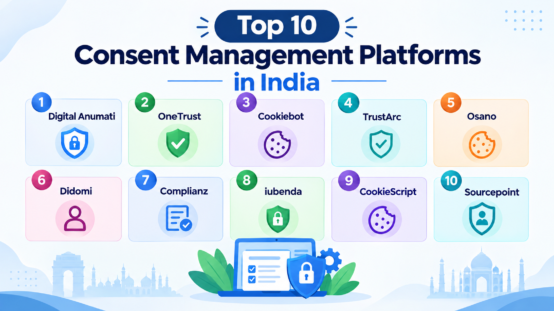
The 10 platforms covered here, namely Digital Anumati, OneTrust, Cookiebot, TrustArc, Osano, Didomi, Complianz, iubenda, CookieScript, and Sourcepoint, approach consent in different ways. Some focus mainly on cookies and websites. Others go further into preference management, mobile apps, advertising ecosystems, identity, privacy governance, and enterprise integrations.
For organizations in India, the right choice comes down to your actual data flows, consent use cases, regulatory obligations, integration needs, security expectations, and ability to scale.
Start by mapping how consent is collected and where personal data moves. Then look at the technology.
Buying a CMP first and working out the requirements afterward is a very efficient way to end up with the wrong one.