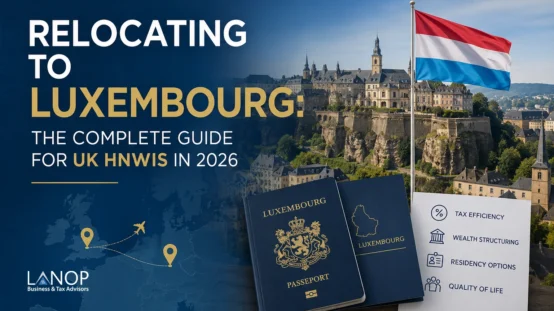
Relocating to Luxembourg: The Ultimate Guide for UK HNWIs
For UK high net worth individuals, relocating to Luxembourg can be a strategic decision involving wealth, business, family, lifestyle, and long-term financial planning. Luxembourg combines political stability, sophisticated financial services, European connectivity, and an international environment, making it an attractive destination for entrepreneurs, investors, executives, and affluent families.
However, moving countries is more than changing an address. Immigration status, UK tax residence, Luxembourg taxation, investments, inheritance planning, business interests, banking, property, and family arrangements should be considered together. For HNWIs, careful preparation before departure can help avoid unnecessary complications and support better financial decisions.
Why Are UK HNWIs Considering Luxembourg?
Luxembourg is one of Europe’s established financial centres, with extensive expertise in private banking, investment funds, wealth management, insurance, and cross-border finance. Its central European location also provides convenient access to Belgium, France, Germany, and other major European markets.
Beyond financial services, Luxembourg offers modern infrastructure, international education, multilingual communities, public services, and a stable environment. These factors can make the country appealing to wealthy families seeking European access while maintaining a high quality of life.
For many individuals, the attraction is therefore broader than taxation. A successful move should combine financial objectives with family, professional, and lifestyle priorities.
Residence and Immigration After Brexit
Brexit changed the position of British nationals moving to Luxembourg. UK citizens who were already legally resident in Luxembourg before the end of the transition period may benefit from protections under the EU UK Withdrawal Agreement.
British nationals moving from the UK now generally need to consider the immigration rules applicable to third country nationals. The appropriate Luxembourg residence permit depends on individual circumstances, such as employment, self-employment, family reunification, private reasons, or another qualifying route.
Some residence routes require procedures to begin before entering Luxembourg. Depending on the circumstances, applicants may need temporary authorisation, registration after arrival, and a residence permit.
Therefore, immigration planning should be one of the priorities when moving to Luxembourg from the UK.
Understanding UK Tax Residence
One of the most important issues for anyone leaving Britain is UK tax residence. Becoming resident in Luxembourg does not automatically end UK tax obligations.
The UK Statutory Residence Test remains central to determining whether someone is UK resident. The assessment can involve days spent in Britain together with factors such as accommodation, family, work, and other connections.
This is particularly important for HNWIs who expect to travel regularly between Luxembourg and the UK. Maintaining accurate records of travel dates, UK accommodation, work activity, and significant connections can be essential.
A detailed UK expatriate tax planning review should therefore take place before the move rather than after relocation.
Luxembourg Tax Planning
A comprehensive relocation strategy should also assess Luxembourg tax residence and the individual’s expected tax position.
Depending on circumstances, the analysis may cover employment income, investment income, capital gains, property, pensions, companies, and other sources of wealth.
HNWIs should avoid assuming that changing residence automatically produces a lower overall tax burden. The correct comparison requires an assessment of both countries and the individual’s complete financial structure.
A coordinated cross-border tax planning strategy can help identify reporting requirements, potential liabilities, and planning opportunities before major decisions are made.
Investments and Wealth Structures
Before relocating to Luxembourg, individuals should review shares, investment portfolios, private companies, funds, trusts, pensions, property, and other significant assets.
The timing of transactions can be important. Selling an investment before leaving the UK may have different consequences from selling it after becoming Luxembourg resident. Restructuring companies or transferring assets can also create tax and legal implications.
For this reason, international wealth planning should take place before major disposals, transfers, or reorganisations.
A well planned approach allows an HNWI to understand the consequences of different options instead of making decisions based solely on the relocation date.
Inheritance Tax and Succession Planning
Inheritance planning deserves particular attention following the UK’s move from domicile-based rules to a long-term UK residence framework from 6 April 2025.
Under the new framework, certain individuals who qualify as long-term UK residents can remain within the scope of UK Inheritance Tax on overseas assets. Leaving Britain does not necessarily remove exposure immediately, and the period of continuing relevance depends on previous UK residence history.
Consequently, Inheritance Tax planning should form part of the relocation process.
Wills, trusts, family investment companies, property ownership, succession arrangements, and powers of attorney should be reviewed where appropriate. Families with substantial international assets may benefit from coordinating UK and Luxembourg advice.
Private Banking and Wealth Management
Luxembourg’s financial sector is a significant attraction for affluent international families. Private banking in Luxembourg can provide access to investment management, portfolio services, funds, financing, and international wealth solutions.
However, opening a banking relationship involves more than transferring funds. Financial institutions typically conduct detailed due diligence covering identity, tax residence, source of wealth, source of funds, and the purpose of the relationship.
The objective should be to establish a financial structure that supports liquidity, investment objectives, family requirements, risk management, and long-term wealth preservation.
Property, Education and Family Life
Property is another important consideration when relocating to Luxembourg. Luxembourg City and surrounding areas offer different residential environments, commuting patterns, and housing options.
HNWIs should consider whether purchasing or renting is more appropriate based on their expected period of residence, family requirements, and investment objectives.
Education can also influence the decision. International schools in Luxembourg may be attractive to families seeking English language or international curricula. Availability, location, fees, and admissions should be investigated well before moving.
Families should also consider healthcare, travel arrangements, spouses, dependants, and how frequently they expect to return to the UK.
Business Owners and Entrepreneurs
For entrepreneurs, setting up a business in Luxembourg can provide access to European markets and a sophisticated commercial environment. However, business structures should be based on genuine commercial objectives rather than relocation alone.
A UK company managed from Luxembourg can raise questions involving management, control, corporate residence, payroll, social security, and taxation.
Business owners should therefore review where strategic decisions are made, where employees operate, and where business activities actually occur.
Practical Checklist Before Moving
Before Relocating to Luxembourg, UK HNWIs should:
- Confirm the appropriate immigration route.
- Review UK and Luxembourg tax residence.
- Track UK travel days and relevant connections.
- Review investments, companies, trusts, pensions, and property.
- Assess the timing of planned asset disposals.
- Review Inheritance Tax and succession exposure.
- Evaluate private banking and wealth management options.
- Plan housing and education requirements.
- Review business and employment arrangements.
- Coordinate professional advice before major changes.
Final Thoughts
Relocating to Luxembourg can offer UK HNWIs a compelling combination of European connectivity, financial expertise, stability, and international lifestyle opportunities. However, the strongest outcomes come from treating relocation as a complete financial and personal project.
The objective should not simply be to leave the UK or obtain Luxembourg residency. It should be to create a structure that works across tax, wealth, business, family, and lifestyle considerations.
With careful Luxembourg relocation planning, informed UK expatriate tax planning, and coordinated professional advice, affluent individuals can approach the move with greater clarity and confidence. Starting early provides more opportunity to identify potential issues, compare alternatives, and make informed decisions before relocation becomes difficult to change.
Disclaimer: This article is provided for general informational purposes only and does not constitute legal, tax, immigration, financial, or investment advice. UK and Luxembourg rules may change and can vary according to individual circumstances. Readers should obtain appropriate professional advice before making decisions based on the information in this article.
References
- HMRC — Statutory Residence Test (SRT)
- GOV.UK — Tax if you leave the UK to live abroad
- Luxembourg Government — Residence for Third-Country Nationals
- Luxembourg Government — British Nationals and the Withdrawal Agreement
- GOV.UK — Luxembourg Tax Treaties
- HMRC — Inheritance Tax if You’re a Long-Term UK Resident
- Luxembourg for Finance—Banking and Wealth Management