Presbyopia: The Day I Realized My Eyes Were Quietly Changing
There was a time when I could read anything without effort. Tiny letters on medicine covers, small fonts in newspapers, messages on my phone in low light – everything felt easy. I never thought about my eyes because they simply worked. But somewhere after my mid-thirties, I started noticing something strange.
I was holding my phone a little farther away.
At first, I ignored it. I thought maybe my eyes were tired after work or because I spent too much time on the computer. But slowly, that small habit became part of my daily life. Reading WhatsApp messages became easier only when I increased the font size. Book letters started looking crowded. Restaurant menus felt uncomfortable in dim light. I realized something had changed.
That was my first real experience with presbyopia.
The Funny Beginning Nobody Talks About
Most people think eye problems come suddenly, but presbyopia enters life very quietly. You don’t wake up one morning blind to small letters. It happens slowly. One day you stretch your arm a little more while reading. Another day you switch on brighter lights to read comfortably. Later, you start zooming in every document on your phone or laptop.
At first, I blamed mobile phones.
Like many people, I believed excessive screen use had weakened my eyesight completely. I thought years of staring at computers and phones had damaged my eyes forever. But after reading more and talking to others around my age, I understood something important – this happens naturally to almost everyone.
Some notice it at 38. Some at 42. Some even earlier.
The eye’s natural lens slowly loses flexibility with age. That flexibility is what helps us focus on nearby objects. When we are young, the eye adjusts quickly. As age increases, that focusing ability becomes weaker.
That is presbyopia.
When Screenshot Zoom Became My Reading Glass
One habit slowly became part of my daily life without me even noticing it.
Whenever I receive a document, poster, or small text image on my phone, I first take a screenshot of it. Then I zoom into the screenshot to read comfortably. Earlier, I could simply open and read things directly. Now, small text inside posters, advertisements, or PDF files often feels difficult unless I enlarge it.
At first, I thought maybe mobile designers were making fonts too tiny. But later I realized other people around me were reading the same thing comfortably while I was struggling.
That small habit – screenshotting just to zoom and read – became one of the clearest signs that my near vision had changed.
The Sewing Machine Moment That Hurt Me Emotionally
One moment affected me more than anything else.
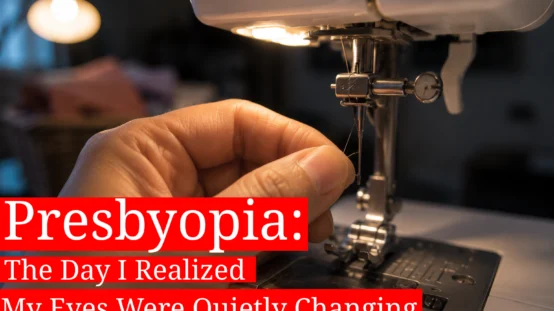
My mother has a sewing machine at home. Earlier, whenever she needed help, I could easily put the thread into the needle. It was such a simple thing that I never even thought about it.
But nowadays, I struggle to do it.
I try once… twice… three times… and the tiny needle hole refuses to become clear. Sometimes I move the thread farther away, sometimes closer. I even blamed the room lighting and thought our bulb was too dim.
Meanwhile, my mother calmly wears her regular glasses and does it easily within seconds.
That moment honestly disappointed me emotionally.
Not because of the sewing machine itself, but because it made me realize that the problem was no longer the light, the thread, or the needle. The real issue was my eyes changing with age.
It was probably the first time I truly accepted that presbyopia had entered my life.
Modern Life Makes Us Notice It Earlier
Even though presbyopia is natural, I still believe modern digital life makes the symptoms feel stronger.
Years ago, people didn’t spend ten or twelve hours looking at close objects. Today, our eyes continuously focus on:
- mobile screens
- laptops
- tablets
- smart watches
- televisions
- small text notifications
Our eyes rarely get rest.
After a full day of screen work, I could feel heaviness around my eyes. Sometimes the letters became slightly blurry for a few seconds before becoming clear again. During night time, reading became even harder.
I don’t think phones directly “destroy” eyesight the way people fear, but they definitely increase eye strain and make us realize our focusing problems much earlier.
In earlier generations, maybe people noticed presbyopia only while reading newspapers. Today, we notice it every ten minutes because our entire life happens through screens.
The Emotional Side Nobody Mentions
What surprised me most was not the reading difficulty itself. It was the emotional feeling behind it.
Presbyopia quietly reminds you that your body is changing.
When you are young, your body feels automatic. You don’t think about joints, digestion, sleep quality, or eye focus. But after thirty-five, small changes begin appearing one by one. Presbyopia becomes one of those early reminders that time is moving.
The first time I increased the font size on my phone permanently, I felt strange. It sounds funny, but it honestly felt like crossing into another phase of life.
Then I noticed my friends doing the same thing.
One friend started using reading glasses in restaurants. Another began zooming every PDF file during office work. Someone else complained that medicine labels had become impossible to read.
That’s when I understood – this is not a personal weakness. It is a shared human experience.
Why Small Letters Became My Enemy
The most frustrating part of presbyopia is not blindness. It is inconsistency.
Some days my eyes feel perfectly normal. Other days, especially after long screen use, small letters become tiring within minutes.
Low light became my biggest enemy.
Earlier, I could read comfortably in dim rooms. Now I automatically search for brighter lighting. I also noticed that sleep affects eye comfort. If I sleep poorly, reading becomes harder the next day.
Another interesting thing is distance.
If the phone is too close, letters blur slightly. When I move it farther away, clarity improves. That small movement became automatic without me realizing it.
This is probably the most common sign of presbyopia:
holding things farther away to read clearly.
Reading Glasses Are Not Defeat
At first, I resisted the idea of reading glasses.
I thought:
“If I start using glasses now, my eyes will become weaker.”
Many people believe this, but I slowly learned that reading glasses are not making the eyes lazy. They are simply reducing strain.
Using proper glasses is similar to using proper lighting while reading. They help the eyes work comfortably instead of struggling continuously.
Once I accepted that idea, my mindset changed. In fact, that realization later inspired me to write my detailed blog, Presbyopia: Reading Glasses Are Not Defeat, because I understood the real struggle was not only about vision – it was also about ego, fear, and accepting natural changes in life.
There is nothing embarrassing about needing help for near vision after forty. In fact, millions of people experience exactly the same thing. Some just hide it better than others.
Now I understand why many older people carry glasses everywhere:
- in pockets
- on office tables
- inside cars
- near beds
It is not fashion. It is survival.
How Presbyopia Changed My Screen Habits
One good thing happened because of this experience: I became more conscious about eye care.
Earlier, I could spend hours continuously looking at screens without a break. Now my eyes force me to pause. Surprisingly, that improved my overall comfort.
I started following simple habits:
- increasing font sizes
- reducing brightness at night
- taking short breaks
- blinking more often
- avoiding unnecessary screen scrolling
- keeping proper distance from monitors
I also discovered that dry eyes play a major role. Continuous screen use reduces blinking, which creates irritation and fatigue. Sometimes the problem is not vision power itself but dryness and eye strain together.
Now I understand why older people often prefer printed books over phone reading. Paper feels softer and less aggressive to the eyes compared to bright digital screens.
The Biggest Mistake People Make
Many people panic when they notice presbyopia symptoms.
They immediately think:
“My eyesight is getting destroyed.”
“Mobile phones ruined my eyes.”
“Soon I won’t see properly.”
But presbyopia is not blindness.
It is a normal age-related focusing change.
Of course, proper eye checkups are important because sometimes other conditions like astigmatism or dryness can exist together. But simple near-vision difficulty after the late thirties is extremely common.
The real problem is not presbyopia itself.
The real problem is how modern life demands constant near focus every single day.
Humans were not designed to stare at glowing rectangles for fourteen hours daily.
What I Learned About Aging
Presbyopia taught me something bigger than eye health.
Aging does not happen suddenly. It arrives through small adjustments.
One day you need brighter light.
One day you stretch your arm farther.
One day you increase font size.
One day you buy reading glasses.
Life continues normally, but tiny changes slowly rewrite daily routines.
Instead of fearing these changes, I think acceptance makes life easier.
Our parents experienced this.
Their parents experienced it.
We are simply reaching the same stage.
The difference is that our generation experiences it through smartphones and computer screens instead of newspapers and books.
Can Presbyopia Be Cured After Some Age?
This is a question many people silently ask themselves.
I also wondered:
“Will my eyes become normal again later?”
From what I understand, presbyopia usually does not completely reverse naturally because it happens due to age-related stiffening of the eye’s natural lens. As age increases, the lens loses flexibility little by little.
That means the focusing difficulty may slowly continue over time.
But the positive side is this:
People adapt very well to it.
Some use reading glasses.
Some increase screen sizes.
Some use proper lighting.
Some choose progressive lenses.
After a while, these adjustments become part of normal life, and people stop thinking about it constantly.
So maybe the real “cure” is not becoming twenty years old again- it is learning how to live comfortably with changing eyes without fear or frustration.
The Day I Stopped Blaming the Screen and Started Understanding My Eyes
Today, I no longer feel worried when I zoom text or increase font size. I don’t consider it a weakness anymore. It is simply adaptation.
Presbyopia is not the end of sharp vision. It is just the beginning of understanding our eyes differently.
In fact, this condition taught me to respect my body more.
- rest matters
- lighting matters
- screen habits matter
- sleep matters
- eye care matters
Most importantly, I learned that growing older is not about losing ability. It is about learning new ways to stay comfortable.
So if you are in your late thirties or forties and suddenly struggling with small letters, welcome to the club. You are not alone.
Your eyes are not failing.
They are simply changing with time – just like the rest of life.