Benefits of Outsourcing Accounting Services UK: Cost Savings, Compliance & Scalability
Running a growing business often creates a strange financial problem. Revenue may be increasing, customers may be multiplying, and opportunities may be appearing every month, yet the accounting workload can quietly become one of the biggest operational pressures. Invoices need processing, transactions need reconciling, records need updating, reports need preparing, and deadlines cannot be ignored. For many owners, the question is no longer whether accounting matters. It is how to manage it without allowing routine finance work to consume valuable time.
This is where Outsourcing Accounting Services UK can make a meaningful difference. Instead of building a large internal finance department, businesses can work with experienced professionals who manage essential accounting activities through organised, technology-enabled processes. The result can be lower overhead, stronger financial visibility, better compliance support, and a more flexible operating model.
The real value, however, goes beyond saving money. For UK companies operating in a competitive environment, that combination of efficiency and flexibility can become a genuine advantage.
What Are Outsourcing Accounting Services UK?
Outsourcing Accounting Services UK means assigning selected or complete accounting responsibilities to an external specialist rather than managing every activity internally. The exact scope depends on the business. Some companies outsource basic bookkeeping, while others use a broader finance function covering reconciliations, accounts payable, accounts receivable, management reporting, month-end preparation, and financial analysis.
A professional outsourced accounting services model can be structured around recurring workflows and clear responsibilities. This helps businesses know what is being handled, when it is due, and who is accountable for the work.
Common services may include:
- Outsourced bookkeeping services for recording and organising financial transactions
- Bank and credit card reconciliations
- Invoice processing and accounts payable support
- Customer invoicing and accounts receivable management
- Month-end accounting support
- Management accounts and financial reporting
- Cash flow reporting and monitoring
- Data cleanup and accounting system support
- Preparation assistance for year-end accounts
- UK accounting services aligned with business requirements
The important point is that outsourcing does not have to mean giving up control. Businesses can retain strategic ownership while transferring repetitive or specialist workloads to a dedicated team.
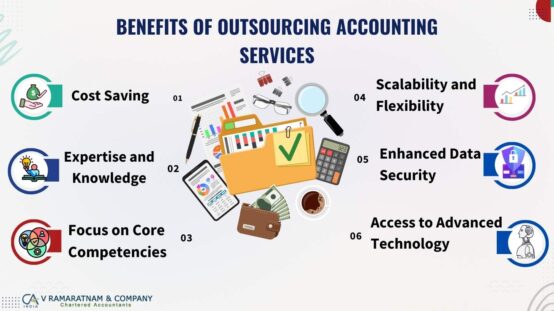
1. Lower Accounting Costs Without Sacrificing Capability
Cost efficiency is one of the most visible advantages of outsourcing. Hiring an internal accountant involves more than salary. Businesses may also need to consider recruitment costs, employment benefits, training, software, equipment, office space, annual leave, sick leave, and the management time required to maintain the function.
With accounting outsourcing UK solutions, companies can often access professional support through a more predictable commercial model. They pay for an agreed scope of work rather than carrying the full cost of maintaining an internal department.
This can be particularly useful for startups and SMEs. A smaller company may need high-quality accounting support but not enough work to justify a full-time finance team. Outsourcing allows the business to access appropriate expertise without creating unnecessary fixed overhead.
The savings can also come from improved efficiency. Experienced teams use standard procedures, accounting software, checklists, and review processes to complete recurring tasks consistently. When routine work is organised properly, less time is lost to duplicated effort, avoidable corrections, and administrative delays.
2. Stronger Support for UK Compliance
Financial compliance is not an area where businesses can afford casual processes. Incorrect records, missed deadlines, incomplete documentation, or inconsistent procedures can create unnecessary risk.
One of the key benefits of outsourcing accounting is access to professionals who understand the processes required to maintain organised financial records and support compliance activities. Businesses can establish clear workflows for transaction recording, reconciliations, documentation, reporting, and deadline tracking.
Reliable UK bookkeeping and accounting support can also make it easier to identify discrepancies before they become larger problems. Regular reconciliation and review create opportunities to spot unusual transactions, missing documents, duplicated entries, or inconsistencies in financial data.
Outsourcing does not remove the legal responsibilities of a business or automatically guarantee compliance. Instead, it provides structured operational support that can make compliance requirements easier to manage. The right provider should work with clearly defined responsibilities, review procedures, secure access controls, and appropriate escalation processes.
3. Better Scalability for Growing Businesses
Growth changes accounting requirements quickly. A company that can manage its finances with a small internal team at one stage may struggle once transaction volumes increase, new employees join, additional products are launched, or the business expands into new markets.
This is where scalable accounting solutions become valuable.
Outsourcing provides a flexible way to increase accounting capacity as workload grows. Instead of recruiting every time the business reaches a new level of activity, management can adjust the outsourced scope or team capacity.
For example, an ecommerce company may experience major increases in transactions during seasonal campaigns. A professional outsourced finance team can help manage higher volumes without requiring the company to permanently maintain the same level of internal staffing.
Scalability also works in the other direction. If workload temporarily decreases, the business may be able to reduce the level of support instead of carrying unnecessary permanent overhead.
4. Access to Experienced Accounting Professionals
Recruiting capable finance professionals can be difficult, particularly when a business needs several skills at once. An internal hire may be strong in bookkeeping but less experienced in reporting, process improvement, or financial analysis.
Outsourced finance teams can provide access to people with different areas of expertise. Depending on the provider and engagement model, a business may receive support from bookkeepers, accountants, finance specialists, reporting professionals, and managers.
This can give SMEs access to capabilities that might otherwise be expensive to build internally.
The advantage is not simply having more people. It is having a structured team where responsibilities can be divided according to skill and workload. This can improve continuity and reduce the risk associated with depending entirely on one employee.
5. More Accurate and Organised Financial Records
Business decisions are only as reliable as the financial information behind them. If records are incomplete or reconciliations are delayed, management may struggle to understand the company’s real financial position.
Professional accounting support services can introduce consistent processes for recording transactions, reconciling accounts, reviewing information, and preparing reports.
Better organisation can help businesses answer practical questions more quickly. How much cash is available? Which invoices remain unpaid? What are the current expenses? Are margins improving? Which areas are generating the strongest returns?
When financial information is maintained consistently, owners can spend less time searching for answers and more time using those answers.
6. Faster Month-End and Management Reporting
Month-end can become a stressful period when accounting tasks are handled informally. Missing documents, unreconciled accounts, unclear ownership, and last-minute adjustments can delay reporting.
A structured outsourced accounting team can create a repeatable month-end workflow. Tasks can be assigned, deadlines can be documented, and review points can be established before reports reach management.
This supports faster access to management accounts, which can help business leaders understand performance while information is still relevant.
Timely reporting is particularly valuable for growing businesses. Waiting several weeks to understand what happened last month makes it harder to respond quickly. A consistent reporting rhythm supports better decisions about spending, hiring, pricing, cash flow, and investment.
7. Greater Focus on Core Business Activities
Business owners often become trapped in administrative work because accounting tasks feel too important to ignore. Yet spending hours reviewing transactions or chasing missing paperwork can take attention away from activities that directly contribute to growth.
By using outsourced accounting solutions, leaders can move routine finance responsibilities into a managed workflow. They can still review reports, approve important decisions, and maintain oversight without personally completing every accounting task.
This creates a healthier division of responsibilities. Finance professionals manage financial processes, while owners and senior managers focus on strategy, customers, partnerships, operations, and growth.
8. Improved Cash Flow Visibility
Profitability and cash availability are not the same thing. A profitable company can still experience cash pressure when customers pay slowly, expenses arrive unexpectedly, or working capital is poorly managed.
Reliable bookkeeping and reporting can improve visibility over cash movement. Cash flow management services can help businesses monitor receivables, payables, recurring expenses, and upcoming obligations.
With better information, management can identify potential pressure earlier and make informed decisions. This may include following up on overdue invoices, reviewing spending, adjusting payment schedules, or planning for seasonal fluctuations.
The benefit is not simply a better spreadsheet. It is greater awareness of what the business can realistically afford at a given moment.
9. Access to Modern Accounting Technology
Technology has changed the way businesses manage finance. Cloud accounting platforms, automated transaction feeds, digital invoicing, document management, and reporting tools can reduce manual work and improve visibility.
A capable cloud accounting services UK provider can help businesses use these technologies within a structured process. The objective should not be to add software for the sake of it. Technology should make accounting easier, faster, more accurate, and more accessible.
Outsourcing can also help smaller businesses benefit from technology without requiring an internal specialist to manage every system.
10. Reduced Dependence on One Employee
When one person handles the entire finance function, an unexpected absence can create significant disruption. Important knowledge may exist only in that employee’s files, inbox, or memory.
A structured outsourced bookkeeping and accounting arrangement can reduce this dependency by documenting procedures and distributing knowledge across a team. Standard operating procedures, shared records, review processes, and defined responsibilities help create continuity.
This is especially important during holidays, illness, recruitment gaps, or periods of rapid growth.
How to Choose the Right Accounting Outsourcing Partner
Not every outsourcing provider operates in the same way. Price should be considered, but it should not be the only factor.
Businesses should assess whether a provider understands UK accounting requirements, communicates clearly, uses secure processes, provides transparent reporting, and can scale with changing needs.
It is also important to define the scope before work begins. Which tasks will be handled? Who reviews the work? What are the turnaround times? How will exceptions be escalated? Which systems will be used? What level of reporting will management receive?
A strong provider should be able to explain its workflow clearly rather than offering vague promises.
Is Outsourcing Right for Your Business?
Accounting services for UK businesses can be valuable for companies at different stages. Startups may use outsourcing to establish disciplined financial processes from the beginning. SMEs may use it to reduce workload and access expertise. Larger organisations may outsource specific processes to improve efficiency and capacity.
The best approach depends on the company’s size, transaction volume, internal skills, budget, technology, and growth plans.
Businesses should also consider outsourcing when accounting work is consistently falling behind, management lacks timely financial information, internal staff are overloaded, or hiring a complete finance team does not make commercial sense.
Final Thoughts
The strongest case for Outsourcing Accounting Services UK is not simply that another team can complete accounting tasks. The real advantage is the ability to build a more organised, flexible, and dependable finance operation without carrying unnecessary internal complexity.
From cost savings and compliance support to scalability, reporting, technology, and improved cash flow visibility, outsourcing can help UK businesses create a stronger foundation for sustainable growth. When routine accounting work is handled through clear processes, experienced professionals, and consistent quality controls, business leaders gain something even more valuable than reduced workload: confidence in the information they use to make decisions.
Eco Outsourcing supports businesses with structured finance and accounting solutions designed to reduce operational pressure while keeping work organised and visible. For companies considering outsourced accounting services, the right partner can become an extension of the internal team, helping maintain reliable processes while allowing leadership to focus on the future.
Outsourcing works best when it is treated as a strategic business decision rather than simply a way to reduce costs. With the right scope, controls, communication, and professional support, it can give growing UK businesses the financial structure and flexibility they need to move forward with confidence.
Disclaimer: This article is provided for general informational purposes only and does not constitute accounting, tax, legal, or financial advice. UK accounting and tax requirements can vary depending on the circumstances of a business and may change over time. Businesses should obtain appropriate professional advice based on their individual circumstances.