Awareness

Important Questions from First Week of Embryonic Development

In this article, let’s discuss today some important questions related to the first week of embryonic development and these are the basic questions also. So, the first question you can see here when does a secondary oocyte complete its second meiotic division to become a mature ovum? So, these are the options.

Very important is the calcium wave in oocyte. So here you can see here that this calcium wave in oocyte when it begins that is when this pump so here penetrates this corona radiata cell layer and the zona pellucida and when it makes contact with the foetal end membrane. So therefore, we’ve written so here it is written that the calcium wave in oocyte begins or happens after penetration of corona radiata cell layer and zona pellucida and the result of this calcium wave in oocyte is that so here basically it causes the resuming of second meiotic division of oocyte and you already know that so here due to the second meiotic division of oocyte only that is secondary oocyte converted into a mature ovum.

So therefore, the correct answer is the at fertilisation. Why? Because that this penetration of so here a penetration of zona pellucida is also a step of so here penetration of zona pellucida is also a step of fertilisation. So now you can see here the correct answer is option C and now for understanding I’ve written in this way so here see that is when the sperm penetrates the zona pellucida then calcium wave of oocyte occurs and this calcium wave of oocyte resumes the second meiosis sorry meiosis to the secondary oocyte and since penetration of zona pellucida is a step of fertilisation so therefore the correct answer is option C that is at fertilisation.

Now third question so here next question you can see how soon after fertilisation occurs within the uterine tube does the blastocyst begin implantation. If you see basically implantation period is between 6 to 12 days after fertilisation so therefore and you already know basically the first week of embryonic development is from the day 1 to day 6 so therefore almost at the last day of the first week of embryonic development that is implantation begins so therefore that implantation period is between 6th and 7th day sorry 7th sorry 6th and 12 days after fertilisation. That’s a question now here if you see the question so here basically now how soon after fertilisation occurs within the so therefore that since it is not written about the day 6 but now if you see that within minutes no by 12 by 12 hours no now basically if you see that all these are the processes or the days a period so first week of embryonic development but this occurs at the almost at the last or the beginning of the second week so therefore the so here almost for the best answer is the option E day 7 so therefore I also have so see friends so here since implantation occurs almost at the last day of first week of embryonic development and the first week of first week is from day 1 to day 6 so therefore the correct answer is almost that is by day 7 option E. Now the next question is very simple where does a blastocyst normally implant so before this you should already know that for that is implantation that is the endometrium the layer of endometrium has to undergo some cyclic changes and that layer of so here endometrium which can undergo such cyclic changes so here in that layer only so here implantation normally occurs and since the so here layer is the function layer of the endometrium only and all the remaining layers they don’t undergo such changes so therefore the correct answer is option B so therefore I have written that in this way so here that since the functional layer of endometrium is the upper layer of uterus and it undergoes cyclic changes during menstruation whereas the other layers like the basal layer also in fact doesn’t undergo any changes so therefore the correct answer is option B. This is a very interesting question which of the following events is involved in the cleavage of the gygo during the week 1 of embryonic development.

If you see here that this is the fertilised egg now here so as you know that through the cleavage process that this fertilised egg undergoes an unequal number of divisions and also you can see here that and as a result so here basically that from this a single cell first of all two cells formed and three cells and finally at the last so here basically multiple cells are formed and this so here basically cells which are formed after the cleavage process and all these cells are the blastomeres. Now here if you see that the size of the blastomeres so here is smaller than the normal fertilised egg or a normal gygo so therefore you can mention that through the process of cleavage so here blastomeres are formed and these blastomeres they have smaller size so therefore so a cleavage process creates blastomeres having size smaller than the fertilised egg or the gygo. So therefore, we have written that since through the cleavage process the gygo fertilised egg undergoes unequal divisions to produce numerous cells called blastomeres and since the size of blastomeres smaller than the gygo so therefore I can say that cleavage involved in the event decrease so here because the size is less in size of blastomeres and blastomeres what basically all the cells which are produced by the unequal division of the gygo so therefore the correct answer is option E. Now here also if you want to see so here this is the correct answer so here basically that a decrease in size of blastomeres if you want to see basically option D not an increase in size of blastomeres no a series of meiotic divisions forming blastomeres it is also not because it is not a meiotic divisions so that’s all yes products on a highly differentiated blastomeres no so here if you see that so here from the cell stage 1 to cell stage 8 all the cells they have similar structures but for the formation of morula that is cell cycle differentiated but not for a cleavage process.

Now the next question if you see that so here basically which of the following structures must degenerate for blastosis implantation to occur so therefore that first of all that you should know that the complete implantation occurs when this blastosis the whole portion of blastosis is within the endometrial stroma. Now it is a it is one of the processes of implantation there are many processes of so here of implantation occurring before this process. Now one of the process is the hatching of blastosis basically disappearing of blast sorry hatching of blastosis where basically zona pellucida disappears or a disappearing of zona pellucida degeneration of zona pellucida.

Second is a decidual reaction and the next is the penetration of blastosis through uterine epithelium and then finally due to this penetration of blastosis through uterine epithelium the whole portion of blastosis so here comes or enters with inside the endometrial stroma so therefore that is the disappearing of zona pellucida is very essential for a complete implantation to occur. So therefore that I have written that answer in this manner that since the implantation completes only when the whole portion of blastosis enters in the endometrial stroma and before the complete enter blastosis in the endometrial stroma the zona pellucida removes. So therefore the appropriate answer is option B. So therefore the option B is so here will be zona pellucida.

Now this question is very interesting which of the following is the origin of mitochondrial DNA of all human adult cells? Now I will tell you why the answer is this and how. So friends you should know that before this sperm head fertilises with a nucleus of this ovum or a nucleus of this ovum or the basically the ovum yes so here till now it is at the secondary site so here not a so here future nucleus of ovum future because so here as you know that as there is no penetration so therefore it is still the secondary site okay but nevertheless so here that is before the head of sperm so here that is futures with the future nucleus of ovum that it has to penetrate these three fertilisation barriers. What are the three fertilisation barriers? The first one is the corona radiata cell, second is the zona pellucida and third is the perivital and membrane and all this penetration occurs through the acrosomal reaction.

Now as you can see here that is after the penetration only the sperm head enters inside this secondary site that is nucleus and all the components tail mitochondria are destroyed. So therefore and you already know that is a sperm comes from the father and here and in the mitochondria only of sperm that is the maternal sorry paternal mitochondria present paternal DNA present and it was destroyed so therefore mitochondrial component or a DNA component is mostly from the mother. So therefore mitochondrial DNA is from maternal in origin.

So therefore that I have written there during the penetration of fertilisation barriers through the acrosomal reaction only the sperm head survives arrest all the components of the sperm like mitochondria till destroyed and sperm from father and egg from mother so therefore mitochondrial DNA of a zygote obtained from mother’s DNA mitochondria so therefore the correct answer is so therefore the correct answer is so here basically the origin of the mitochondrial DNA of all human adult is only maternal type not paternal because the mitochondria of the sperm destroyed during the fertilisation. So here also I have seen that answer is maternal only. So now so friends that you see here that this is a zygote so here cleavage process is going on now here that this is the four cell stage.

So as I mentioned that this D is a four cell stage and here you can see here that at the four cells stage all the cells they are similar to each other now if we culture each cell and then if we make that is a baby or that is a foetus from this cell each of the cell then all the all the babies will have same genetic components why because the cells from which they are originated they are of same same or they are of similar to each other so therefore that I have since since at four cell stage all the blastomere cells produced are similar to one another so therefore if each blastomere cell made to produce baby then all the four babies will have same genetic components so therefore the answer is option C you can see here that so here birth of four genetically identical babies. Now the last question is about in oogenesis which of the following events occurs immediately following the completion of second meiosis so first of all that you should remove the suppose let the answer is suppose this suppose any suppose C then you will have to eliminate the remaining options so let’s eliminate the option B first so as you know that this calcium wave of oocyte occurs after the penetration of corona radiata and zona zona pellucida now and then this calcium wave of oocyte so here causes the completion of second meiosis so that means that this step occurs before the completion of second meiosis so therefore option B is eliminated now so therefore as you know that this completion of cleavage, appearance of blastocyst, degeneration of zona pellucida all these steps occur after fertilisation now if you see that this formation of female pronucleus occurs before fertilisation but now we have to ask basically occurs immediately following the completion of second meiosis so therefore that as you already know that after the completion of second meiosis so here female pronucleus is formed and then when this female pronucleus so here fertilises with the sperm basically male pronucleus then only fertilisation occurs and after the fertilisation that these steps occurs so therefore option E, D and E are also eliminated so therefore the correct answer is option C. So therefore, we have written that since the meiosis to completed after the penetration of corona radiata now and completion of cleavage, blastocyst formation and degeneration of zona pellucida occur after fertilisation and the female pronucleus formation occurs before fertilisation so therefore the correct answer is option C because this occurs immediately after the completion of second meiosis.

Understanding the fundamentals of fertilization, cleavage, blastocyst formation, implantation and early embryonic development is essential for students and professionals aspiring to build a career in reproductive medicine and embryology. Medline Academics offers comprehensive infertility fellowship in India designed to bridge the gap between theoretical knowledge and clinical practice. Through expert-led teaching, simulation training and hands-on experience, learners gain strong foundation. For those seeking specialized training, Medline Academics also offers some of the most structured embryology training courses in Bangalore, India, enabling the participants to develop practical skills in assisted reproductive technologies and modern embryology techniques under experienced faculty guidance.

With a legacy of excellence in reproductive healthcare, Dr. Kamini Rao Hospitals is dedicated to providing comprehensive fertility, gynaecology, obstetric, and reproductive medicine services under the guidance of renowned experts. Established to carry forward the vision of Padma Shri Prof. Dr. Kamini A Rao, this Infertility Hospitals in Bangalore, combines reproductive technologies, state-of-the-art infrastructure, and personalized patient care to support individuals and couples on their journey to parenthood. From fertility assessment and assisted reproductive techniques to women’s health services spanning menarche to menopause, Dr. Kamini Rao Hospitals continues to set benchmarks in  compassionate, evidence based reproductive healthcare.

That’s all about the important questions basically all these questions that we have discussed these are important as well as basic concepts for maintaining or gaining other knowledge in future.


Passenger holding a railway ticket at an Indian railway station platform, illustrating Indian Railways waiting-list tickets, train travel, and reservation booking rules.

I Discovered an Indian Railway Rule That Could Save Your Important Journey

Many railway passengers still do not know this important fact: a waiting-list ticket booked from a railway reservation counter is treated differently from a waiting-list e-ticket booked online. If an online ticket remains fully waitlisted after chart preparation, it is automatically cancelled and cannot be used for travel. However, a counter-booked waiting-list ticket is not automatically cancelled in the same way, which can give passengers additional options depending on railway rules and available accommodation. This was something I discovered during a recent train journey, and it completely changed my understanding of railway travel.

A Late-Night Conversation That Changed My Understanding

A few days ago, I was traveling by train. It was around 1:00 AM, and most passengers in the coach were asleep. During a brief moment when I woke up, I noticed two couples standing near the coach door. They had been there for quite some time, so I became curious and asked why they were standing instead of resting.

One of them explained their situation.

They had booked their train tickets several days earlier from a railway reservation counter. Their tickets were on the waiting list and unfortunately did not get confirmed even after chart preparation. Normally, many people assume that an unconfirmed ticket means the journey is impossible.

However, these passengers seemed calm. They already knew something that I did not know.

They explained that because their tickets were purchased from a railway reservation counter, the tickets were not automatically cancelled in the same way as a waitlisted online ticket. That conversation introduced me to a railway rule that I had never paid attention to before.

Understanding the Difference Between Counter Tickets and Online Tickets

Before this journey, I believed that all waiting-list tickets followed exactly the same rules. Like many passengers, I thought an unconfirmed ticket always meant the end of the journey.

After speaking with those passengers, I started researching the subject and discovered that Indian Railways handles online and counter-booked waiting-list tickets differently.

This difference is important because many travelers book tickets without understanding what happens when their waitlist status does not move to RAC or Confirmed.

What Happens to a Waitlisted Online Ticket?

When a passenger books a waiting-list ticket through the IRCTC website or mobile app, the ticket is considered an e-ticket. If the ticket remains fully waitlisted even after chart preparation, it is automatically cancelled.

The passenger’s name is removed from the reservation chart, and the ticket cannot be used for travel in a reserved coach. The refund process is also handled automatically according to IRCTC rules.

This means that a fully waitlisted online ticket effectively becomes useless for the planned journey once chart preparation is completed.

What Happens to a Waitlisted Counter Ticket?

A waiting-list ticket purchased from a railway reservation counter is handled differently. Unlike a fully waitlisted e-ticket, it is not automatically cancelled after chart preparation.

This is the information that surprised me the most.

However, it is very important to understand one thing correctly. A counter-booked waiting-list ticket does not guarantee a reserved berth or seat. It also does not automatically allow passengers to occupy reserved accommodation. Travellers must follow the latest Indian Railways rules and instructions issued by ticket-checking staff and railway authorities.

Many people misunderstand this point and assume that a counter ticket automatically guarantees the journey in the reserved coach. That assumption can create problems during travel.

How This Information Could Help Travelers

Looking back, I realised how many opportunities I may have missed because I did not know this difference.

Whenever my waiting-list ticket looked unlikely to be confirmed, I often searched for expensive last-minute alternatives. Sometimes I postponed important work. On a few occasions, I cancelled trips completely because I believed there were no other practical options available.

Understanding the distinction between counter-booked tickets and online tickets gives travellers more information when making decisions.

This can be especially useful during festival seasons, school vacations, public holidays, and other peak travel periods when waiting lists become extremely long.

Suppose you check train availability online and discover that your preferred train already has a significant waiting list. If your journey is important and flexibility matters, knowing the differences between booking methods can help you plan more effectively and avoid unnecessary confusion.

Check the Rules Before You Cancel Your Next Journey

The biggest lesson from my late-night train conversation was simple: never assume that a waiting-list ticket tells the entire story. Before cancelling an important trip, take a few minutes to understand the latest railway regulations, check your PNR status, and learn how different booking methods are treated.

A small piece of knowledge can sometimes save a great deal of stress.

Official Reference: Readers can verify the latest waiting list, cancellation, and reservation rules directly from the official Indian Railways and IRCTC resources:

• IRCTC Cancellation & Refund Rules: https://contents.irctc.co.in/en/CancellationRulesforIRCTCTrain.pdf

• Indian Railways Reservation Rules: https://www.indianrail.gov.in

Being aware of the rules before you travel can help you make better decisions and avoid unnecessary disruption to your plans.

A pair of reading glasses resting on an open book in a calm indoor setting, symbolizing the emotional acceptance of presbyopia and the message behind the blog “Reading Glasses Are Not Defeat.

Presbyopia: Reading Glasses Are Not Defeat

This blog is a continuation of my earlier blog, “Presbyopia: The Day I Realized My Eyes Were Quietly Changing.” In that article, I briefly discussed one small but emotional part of my experience – “Reading Glasses Are Not Defeat.” Later, I realized that topic itself carried a much deeper emotional story, especially for people in their thirties and forties who silently struggle with presbyopia but hesitate to accept it.

Because honestly, the problem is not always the eyes.

Sometimes, the real struggle happens inside the mind.

Why Young People Feel Ashamed of Reading Glasses

When people hear about reading glasses, they usually imagine elderly people reading newspapers with spectacles resting at the edge of their noses.

That image itself creates fear for younger people facing presbyopia.

When I started experiencing difficulty reading small letters, I never imagined I would need reading glasses so early. Somewhere inside my mind, wearing glasses felt like announcing to society:
“I am getting old.”

That thought disturbed me more than the blurry vision itself.

I know many youngsters who experience the same thing. They struggle to read messages, zoom phone screens continuously, or hold books farther away but still avoid spectacles because they fear judgment from others.

They think:

  • friends may tease them
  • relatives may say they became old
  • people may think their eyesight became weak
  • spectacles may affect personality or appearance

I had exactly the same feelings.

The Day the Eye Specialist Gave Me Glasses

As my presbyopia symptoms became more disturbing, I finally visited an eye specialist.

She checked my eyesight carefully and prescribed reading glasses. Then she said something very casually:
“Use it regularly for one or two weeks.”

For her, it was probably a simple medical suggestion.

But inside my mind, it felt like a major emotional decision.

I immediately made my own secret plan:
I would use the glasses only during work time.

Only during screen usage.

Never outside.

Never in front of people unnecessarily.

At that stage, my ego was still stronger than my comfort.

The Strange Hide and Seek with Letters

During that period, I struggled badly while reading books and newspapers.

The small blurry letters felt like they were playing hide and seek in front of my eyes.

Sometimes I adjusted the distance.
Sometimes I changed the lighting.
Sometimes I cleaned my eyes with water thinking tiredness was the problem.

Even during those uncomfortable moments, I avoided wearing my glasses for reading.

Why?

Because somewhere inside me, I feared my family members would think:
“My eyesight has become weak.”
“He is becoming old.”

Today, when I think about it, that fear sounds unnecessary. But at that time, it felt emotionally real.

That is the strange thing about presbyopia:
the emotional resistance often becomes stronger than the physical difficulty itself.

How Ego Creates More Eye Strain

After reading more about presbyopia and understanding the condition better, I slowly realized something important.

In the name of ego and unnecessary social fear, I was giving extra stress to my eyes every day.

Instead of helping my eyes, I was forcing them to struggle continuously.

The more I resisted glasses,

  • the more eye strain increased
  • the more headaches appeared
  • the more uncomfortable reading became

That realization changed my mindset completely.

I understood something simple:
Wearing glasses was not making my eyes weak.

Ignoring the problem was creating more discomfort.

The day I emotionally accepted that truth, I started wearing my glasses more naturally.

And honestly, life immediately became easier.

Reading Glasses Are Not Weakness

One dangerous misunderstanding still exists among many people.

They believe:
“If I start using reading glasses once, then I can never live without them.”

This fear prevents many people from getting proper help.

But reading glasses are not an addiction.

They are supportive.

They simply help the eyes focus more comfortably after the natural lens inside the eye loses flexibility with age.

In fact, struggling continuously without proper correction often creates more stress and frustration.

We never feel ashamed about using:

  • proper lighting
  • supportive chairs
  • comfortable shoes

Then why should we feel ashamed about helping our eyes see comfortably?

My Mother’s Experience Changed My Thinking

One of the biggest lessons came from my mother’s life.

I know her as a passionate reader. She loves:

  • books
  • newspapers
  • magazines

Reading was part of her daily happiness.

But during her forties, she also started suffering from presbyopia.

At that time, someone advised her something completely wrong:

don’t wear glasses
don’t force reading
presbyopia will automatically cure later
if glasses are used once, they become permanent forever

Believing that advice, she reduced reading slowly.

That period disappointed her deeply.

A person who genuinely loved reading suddenly stopped enjoying one of her favorite activities because of fear and misinformation.

Later, when I understood her struggle, I took her to an eye specialist.

She started wearing proper reading glasses.

Honestly, it became a small revolution in her life.

She returned to:

  • reading books
  • newspapers
  • magazines

More importantly, she returned to her favorite work – tailoring.

Today, she spends more time sewing comfortably and even earns money through her work.

That simple pair of spectacles gave back a part of her old lifestyle.

The Sewing Machine Moment That Hurt Me Emotionally

An interesting emotional moment connected both our lives together.

In my earlier blog, Presbyopia: The Day I Realized My Eyes Were Quietly Changing, I wrote about “The Sewing Machine Moment That Hurt Me Emotionally named part.”

That moment became unforgettable for me.

Earlier, I could easily help my mother thread the sewing machine needle. But during my own presbyopia stage, I suddenly struggled to see the tiny needle hole clearly.

Meanwhile, my mother calmly wore her glasses and completed the task within seconds.

The irony was painful.

I was the person who once encouraged my mother to accept spectacles without shame.

But when the same situation entered my own life, I became trapped inside the same ego, doubt, and fear.

That experience taught me how difficult self-acceptance can be sometimes.

Modern Lifestyle Makes Presbyopia More Visible

I also believe our generation experiences presbyopia differently because of digital life.

Today, we constantly use:

  • smartphones
  • laptops
  • tablets
  • televisions

Our eyes rarely rest.

Tiny app fonts, low brightness screens, and continuous close focusing make near-vision problems feel stronger than before.

Sometimes I used to take screenshots only to zoom and read clearly.

At first, I thought this was normal for everyone.

Later, I realized many people around me were reading comfortably while I was struggling silently.

Modern screens may not directly “destroy” eyesight, but they definitely make presbyopia more noticeable in daily life.

Natural Alternatives Instead of Reading Glasses

Many people ask:
“Is there any natural option instead of glasses?”

From my understanding and experience, some habits can definitely reduce strain and improve comfort:

  • better sleep
  • proper lighting
  • reducing excessive screen time
  • taking eye breaks
  • blinking more during screen use
  • healthy diet
  • outdoor activity

Some people also practice eye relaxation exercises and reduce continuous near-focus pressure.

These habits help eye comfort significantly.

But personally, I understood one important thing:
There is a difference between supporting eye health and denying reality.

Healthy habits are excellent.

But if the eyes genuinely need support for comfortable reading, there is no shame in using glasses.

One Big Lesson I Learned About Life

One important lesson changed my thinking completely.

We must understand ourselves honestly.

When our body becomes weaker in some area, we should not punish it with ego.

We should care for it more carefully.

For example:

when health becomes poor, we improve diet
when body becomes weak, we start exercise
when stress increases, we seek rest

Then why should eyes be treated differently?

Eyes also deserve:

  • care
  • support
  • rest
  • proper attention

Once I started caring for my eyes instead of emotionally fighting reality, life became more peaceful.

Acceptance Is More Powerful Than Ego

Today, I no longer feel ashamed wearing reading glasses.

In fact, I feel more frustrated remembering how much unnecessary struggle I created because of simple social fear.

Presbyopia did not make me weak.

It simply reminded me that the body changes with time.

And honestly, there is maturity in accepting that naturally.

Many people silently suffer because they fear judgment from society. But the truth is:
Most people are too busy dealing with their own insecurities to seriously judge someone wearing spectacles.

The real freedom comes when comfort becomes more important than ego.

Reading Glasses Gave Back More Than Vision

At first, I thought spectacles would symbolize aging.

But later, I realized they actually gave back:

  • comfort
  • confidence
  • reading happiness
  • eye relaxation
  • mental peace

Most importantly, they removed the daily frustration of struggling with tiny letters constantly.

Today, I understand something very clearly:

Reading glasses are not defeat.

Defeat is ignoring reality, stressing the eyes unnecessarily, and losing comfort because of fear and ego.

Sometimes maturity begins the moment we stop fighting natural changes and start supporting ourselves with kindness instead.

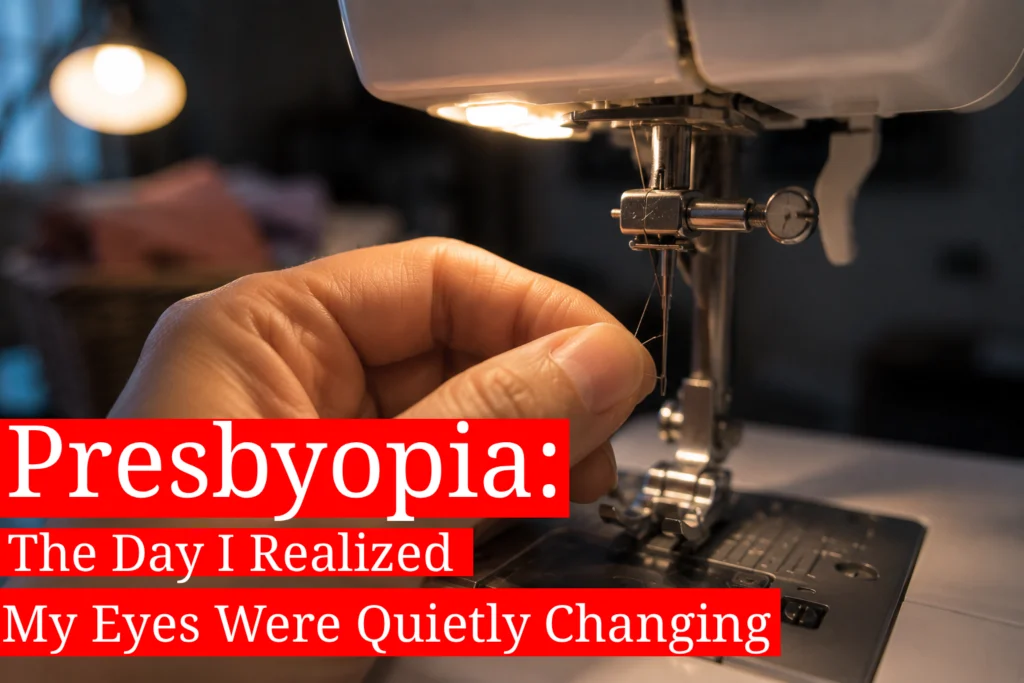
Presbyopia and Near Vision Difficulty While Threading a Sewing Machine

Presbyopia: The Day I Realized My Eyes Were Quietly Changing

There was a time when I could read anything without effort. Tiny letters on medicine covers, small fonts in newspapers, messages on my phone in low light – everything felt easy. I never thought about my eyes because they simply worked. But somewhere after my mid-thirties, I started noticing something strange.

I was holding my phone a little farther away.

At first, I ignored it. I thought maybe my eyes were tired after work or because I spent too much time on the computer. But slowly, that small habit became part of my daily life. Reading WhatsApp messages became easier only when I increased the font size. Book letters started looking crowded. Restaurant menus felt uncomfortable in dim light. I realized something had changed.

That was my first real experience with presbyopia.

The Funny Beginning Nobody Talks About

Most people think eye problems come suddenly, but presbyopia enters life very quietly. You don’t wake up one morning blind to small letters. It happens slowly. One day you stretch your arm a little more while reading. Another day you switch on brighter lights to read comfortably. Later, you start zooming in every document on your phone or laptop.

At first, I blamed mobile phones.

Like many people, I believed excessive screen use had weakened my eyesight completely. I thought years of staring at computers and phones had damaged my eyes forever. But after reading more and talking to others around my age, I understood something important – this happens naturally to almost everyone.

Some notice it at 38. Some at 42. Some even earlier.

The eye’s natural lens slowly loses flexibility with age. That flexibility is what helps us focus on nearby objects. When we are young, the eye adjusts quickly. As age increases, that focusing ability becomes weaker.

That is presbyopia.

When Screenshot Zoom Became My Reading Glass

One habit slowly became part of my daily life without me even noticing it.

Whenever I receive a document, poster, or small text image on my phone, I first take a screenshot of it. Then I zoom into the screenshot to read comfortably. Earlier, I could simply open and read things directly. Now, small text inside posters, advertisements, or PDF files often feels difficult unless I enlarge it.

At first, I thought maybe mobile designers were making fonts too tiny. But later I realized other people around me were reading the same thing comfortably while I was struggling.

That small habit – screenshotting just to zoom and read – became one of the clearest signs that my near vision had changed.


The Sewing Machine Moment That Hurt Me Emotionally

One moment affected me more than anything else.

My mother has a sewing machine at home. Earlier, whenever she needed help, I could easily put the thread into the needle. It was such a simple thing that I never even thought about it.

But nowadays, I struggle to do it.

I try once… twice… three times… and the tiny needle hole refuses to become clear. Sometimes I move the thread farther away, sometimes closer. I even blamed the room lighting and thought our bulb was too dim.

Meanwhile, my mother calmly wears her regular glasses and does it easily within seconds.

That moment honestly disappointed me emotionally.

Not because of the sewing machine itself, but because it made me realize that the problem was no longer the light, the thread, or the needle. The real issue was my eyes changing with age.

It was probably the first time I truly accepted that presbyopia had entered my life.

Modern Life Makes Us Notice It Earlier

Even though presbyopia is natural, I still believe modern digital life makes the symptoms feel stronger.

Years ago, people didn’t spend ten or twelve hours looking at close objects. Today, our eyes continuously focus on:

  • mobile screens
  • laptops
  • tablets
  • smart watches
  • televisions
  • small text notifications

Our eyes rarely get rest.

After a full day of screen work, I could feel heaviness around my eyes. Sometimes the letters became slightly blurry for a few seconds before becoming clear again. During night time, reading became even harder.

I don’t think phones directly “destroy” eyesight the way people fear, but they definitely increase eye strain and make us realize our focusing problems much earlier.

In earlier generations, maybe people noticed presbyopia only while reading newspapers. Today, we notice it every ten minutes because our entire life happens through screens.

The Emotional Side Nobody Mentions

What surprised me most was not the reading difficulty itself. It was the emotional feeling behind it.

Presbyopia quietly reminds you that your body is changing.

When you are young, your body feels automatic. You don’t think about joints, digestion, sleep quality, or eye focus. But after thirty-five, small changes begin appearing one by one. Presbyopia becomes one of those early reminders that time is moving.

The first time I increased the font size on my phone permanently, I felt strange. It sounds funny, but it honestly felt like crossing into another phase of life.

Then I noticed my friends doing the same thing.

One friend started using reading glasses in restaurants. Another began zooming every PDF file during office work. Someone else complained that medicine labels had become impossible to read.

That’s when I understood – this is not a personal weakness. It is a shared human experience.

Why Small Letters Became My Enemy

The most frustrating part of presbyopia is not blindness. It is inconsistency.

Some days my eyes feel perfectly normal. Other days, especially after long screen use, small letters become tiring within minutes.

Low light became my biggest enemy.

Earlier, I could read comfortably in dim rooms. Now I automatically search for brighter lighting. I also noticed that sleep affects eye comfort. If I sleep poorly, reading becomes harder the next day.

Another interesting thing is distance.

If the phone is too close, letters blur slightly. When I move it farther away, clarity improves. That small movement became automatic without me realizing it.

This is probably the most common sign of presbyopia:
holding things farther away to read clearly.

Reading Glasses Are Not Defeat

At first, I resisted the idea of reading glasses.

I thought:
“If I start using glasses now, my eyes will become weaker.”

Many people believe this, but I slowly learned that reading glasses are not making the eyes lazy. They are simply reducing strain.

Using proper glasses is similar to using proper lighting while reading. They help the eyes work comfortably instead of struggling continuously.

Once I accepted that idea, my mindset changed. In fact, that realization later inspired me to write my detailed blog, Presbyopia: Reading Glasses Are Not Defeat, because I understood the real struggle was not only about vision – it was also about ego, fear, and accepting natural changes in life.

There is nothing embarrassing about needing help for near vision after forty. In fact, millions of people experience exactly the same thing. Some just hide it better than others.

Now I understand why many older people carry glasses everywhere:

  • in pockets
  • on office tables
  • inside cars
  • near beds

It is not fashion. It is survival.

How Presbyopia Changed My Screen Habits

One good thing happened because of this experience: I became more conscious about eye care.

Earlier, I could spend hours continuously looking at screens without a break. Now my eyes force me to pause. Surprisingly, that improved my overall comfort.

I started following simple habits:

  • increasing font sizes
  • reducing brightness at night
  • taking short breaks
  • blinking more often
  • avoiding unnecessary screen scrolling
  • keeping proper distance from monitors

I also discovered that dry eyes play a major role. Continuous screen use reduces blinking, which creates irritation and fatigue. Sometimes the problem is not vision power itself but dryness and eye strain together.

Now I understand why older people often prefer printed books over phone reading. Paper feels softer and less aggressive to the eyes compared to bright digital screens.

The Biggest Mistake People Make

Many people panic when they notice presbyopia symptoms.

They immediately think:

“My eyesight is getting destroyed.”
“Mobile phones ruined my eyes.”
“Soon I won’t see properly.”

But presbyopia is not blindness.

It is a normal age-related focusing change.

Of course, proper eye checkups are important because sometimes other conditions like astigmatism or dryness can exist together. But simple near-vision difficulty after the late thirties is extremely common.

The real problem is not presbyopia itself.

The real problem is how modern life demands constant near focus every single day.

Humans were not designed to stare at glowing rectangles for fourteen hours daily.

What I Learned About Aging

Presbyopia taught me something bigger than eye health.

Aging does not happen suddenly. It arrives through small adjustments.

One day you need brighter light.
One day you stretch your arm farther.
One day you increase font size.
One day you buy reading glasses.

Life continues normally, but tiny changes slowly rewrite daily routines.

Instead of fearing these changes, I think acceptance makes life easier.

Our parents experienced this.
Their parents experienced it.
We are simply reaching the same stage.

The difference is that our generation experiences it through smartphones and computer screens instead of newspapers and books.

Can Presbyopia Be Cured After Some Age?

This is a question many people silently ask themselves.

I also wondered:
“Will my eyes become normal again later?”

From what I understand, presbyopia usually does not completely reverse naturally because it happens due to age-related stiffening of the eye’s natural lens. As age increases, the lens loses flexibility little by little.

That means the focusing difficulty may slowly continue over time.

But the positive side is this:
People adapt very well to it.

Some use reading glasses.
Some increase screen sizes.
Some use proper lighting.
Some choose progressive lenses.

After a while, these adjustments become part of normal life, and people stop thinking about it constantly.

So maybe the real “cure” is not becoming twenty years old again- it is learning how to live comfortably with changing eyes without fear or frustration.

The Day I Stopped Blaming the Screen and Started Understanding My Eyes

Today, I no longer feel worried when I zoom text or increase font size. I don’t consider it a weakness anymore. It is simply adaptation.

Presbyopia is not the end of sharp vision. It is just the beginning of understanding our eyes differently.

In fact, this condition taught me to respect my body more.

  • rest matters
  • lighting matters
  • screen habits matter
  • sleep matters
  • eye care matters

Most importantly, I learned that growing older is not about losing ability. It is about learning new ways to stay comfortable.

So if you are in your late thirties or forties and suddenly struggling with small letters, welcome to the club. You are not alone.

Your eyes are not failing.

They are simply changing with time – just like the rest of life.