All Blogs

A dark blue technology-themed graphic with the title “The Truth About AI Detectors” and subtitle “How They Work, Why They Matter, and Where They Fall Short,” featuring a laptop with AI detection and data analytics visuals.

The Truth About AI Detectors: How They Work, Why They Matter, and Where They Fall Short

Somewhere between a nervous student pasting an essay into a text box and a hiring manager scanning a stack of cover letters, a quiet question has become impossible to avoid: did a human actually write this?

That question has spawned an entire category of software — the ai detector — built to answer it. But the honest answer is messier than most of these tools let on. An AI detector doesn’t read minds. It reads patterns. And patterns, as it turns out, can be fooled, misread, and sometimes flat-out wrong.

This article breaks down what AI detectors actually do under the hood, where they’re genuinely useful, where they get it wrong, and how to think clearly about their results instead of treating a percentage score as gospel.

What Is an AI Detector, Exactly?

An AI detector is a piece of software designed to estimate the likelihood that a given piece of text (or, increasingly, images, audio, or video) was generated by artificial intelligence rather than produced by a human. Most people encounter these tools in one of three settings: education, where instructors want to verify original student work; publishing and content marketing, where editors want to confirm authenticity before hitting publish; and hiring, where recruiters want to check whether an application was written by a person or a chatbot.

Despite the branding, no AI detector actually “detects” AI in any literal sense. There’s no fingerprint left behind by ChatGPT or any other language model that a scanner can definitively pull out of a sentence. Instead, these tools make probabilistic guesses based on statistical patterns commonly found in machine-generated writing.

The Core Idea Behind Detection

Language models tend to produce text that is smoother and more predictable than typical human writing. Humans are messier. We vary our sentence length erratically, we make small grammatical missteps, we double back on an idea, and we occasionally choose an odd or unexpected word simply because it feels right. AI-generated text, by contrast, tends to follow the statistically “safest” path through a sentence — which is exactly what makes it sound fluent, and also exactly what can give it away.

How AI Detectors Actually Work

Understanding the mechanics behind an AI detector makes it much easier to trust — or appropriately distrust — its results.

Perplexity: Measuring Predictability

One of the most common signals detectors rely on is called perplexity. In simple terms, perplexity measures how “surprised” a language model would be by a given sequence of words. Text with low perplexity flows in a highly predictable way, closely matching patterns the model has seen before. Text with high perplexity contains more unusual word choices and unexpected phrasing.

Human writing generally scores higher in perplexity because people are inconsistent and idiosyncratic. AI-generated text often scores lower, since the underlying model is, by design, choosing the most statistically likely next word over and over again.

Burstiness: The Rhythm of Real Writing

A second key signal is burstiness, which looks at the variation in sentence length and structure across a passage. Human writers naturally produce a mix of short, punchy sentences and long, winding ones. AI models, especially older ones, tend to generate text with a more uniform rhythm — sentence after sentence of roughly similar length and complexity.

Modern AI detectors combine perplexity and burstiness scores, along with other linguistic markers, and feed them into a classification model trained on large datasets of both human and AI-written text. The output is usually presented as a percentage or a simple verdict: “likely human” or “likely AI-generated.”

Watermarking: A Different Approach Entirely

Some newer detection methods don’t analyze the text after the fact at all — instead, they rely on watermarking built directly into the generation process. Certain AI systems can be designed to subtly bias their word choices in a statistically detectable but invisible-to-humans pattern. A detector built to recognize that specific watermark can then confirm with much higher confidence that the text came from that particular system.

The catch is that watermarking only works if the AI tool that generated the text actually implements it, and if the text hasn’t been edited enough to break the pattern. It’s a promising direction, but far from a universal solution.

Why AI Detectors Aren’t as Reliable as They Seem

This is the part most marketing pages for detection tools gloss over: accuracy is genuinely difficult to guarantee, and false positives are a real, recurring problem.

The False Positive Problem

Non-native English speakers are disproportionately flagged by many detectors. Studies examining this issue have found that popular KI detector GPT detectors frequently misclassify essays written by non-native English speakers as AI-generated, while rarely making the same mistake with essays from native speakers. The likely explanation is that non-native writers often use simpler, more predictable sentence structures — which happens to resemble the low-perplexity patterns detectors associate with machine-generated text.

This isn’t a minor edge case. It means a detector can systematically penalize the exact group of people who can least afford to be wrongly accused of academic dishonesty.

Editing Breaks the Pattern

Lightly editing AI-generated text — rewording a few sentences, reordering paragraphs, adjusting tone — can be enough to push it below a detector’s confidence threshold. This creates an uncomfortable asymmetry: the people most likely to get caught are those who used AI tools carelessly, while more deliberate misuse slips through unnoticed.

Human Writing Can Look “Too AI”

The reverse problem also happens. Clean, well-structured, grammatically careful writing — the kind produced by strong writers, technical professionals, or anyone writing in a formal register — can sometimes score as AI-generated simply because it’s more predictable than average prose. A polished cover letter or a carefully edited essay can trigger a false flag for the “crime” of being well-written.

Where AI Detectors Genuinely Add Value

None of this means AI detectors are useless — it means they need to be used as one signal among several, not as a final verdict.

In Education

Teachers facing a flood of AI-assisted homework can use detection tools as a starting point for a conversation, not as an automatic accusation. A flagged essay is a reason to ask a student to explain their process or show drafts and research notes, not grounds for an immediate penalty.

In Publishing and SEO

Search engines have made it clear that content quality matters more than how it was produced, but publishers still often want to verify that outsourced or freelance content is genuinely original and not lightly rewritten AI output. A detector can serve as a quick quality-control checkpoint before content goes live, especially at scale.

In Hiring and Recruitment

Recruiters sorting through hundreds of applications sometimes use detection tools to flag cover letters that appear entirely AI-generated with no personalization. Used carefully, this can help surface candidates who put in genuine effort — though again, it shouldn’t be the sole basis for rejecting someone.

How to Use AI Detector Results Responsibly

A few practical guidelines make these tools far more useful and far less likely to cause harm:

  • Treat scores as probabilities, not proof. A “97% AI-generated” result is a statistical estimate, not a confession.
  • Cross-check with context. Look at drafts, revision history, writing samples, or a simple conversation before drawing conclusions.
  • Watch for bias against non-native speakers. Apply extra caution and human judgment when reviewing writing from ESL students or international candidates.
  • Combine multiple tools. Different detectors use different models and training data, so results can vary significantly between them; agreement across several tools is more meaningful than a single score.
  • Focus on outcomes over origin. In many contexts — marketing copy, business writing, even schoolwork — what matters most is whether the final product is accurate, valuable, and well-reasoned, not exclusively how it was drafted.

The Future of AI Detection

As generative models keep improving, the gap between human and machine writing patterns will likely keep narrowing, making perplexity- and burstiness-based detection progressively less reliable. The most promising long-term direction is watermarking at the point of generation, paired with industry-wide standards for content provenance and transparency — similar to how digital images can carry metadata about their origin.

In the meantime, expect AI detectors to keep improving incrementally, but don’t expect a tool that offers perfect certainty. The technology generating text and the technology trying to catch it are locked in a continuous back-and-forth, and neither side is likely to declare a permanent win.

Final Thoughts

An AI detector is a useful instrument, not an oracle. It can highlight patterns worth a second look, support a broader review process, and add a layer of quality control where none existed before. What it can’t do is replace human judgment, context, and fairness — especially when the stakes involve a student’s academic record, a job applicant’s opportunity, or a writer’s reputation.

The smartest way to use these tools is the same way you’d use any imperfect instrument: as one input among several, applied with skepticism, and never as the final word.

Explore more informative articles on Blog70.

Why a Bachelor of Applied Arts is the Key to a Creative Career (And Why It’s Not Just Painting!)

Try telling your family you want to study “Arts.” Mostly, you’ll just get a worried look followed by, “but how will you earn?”. We all know how much desi parents panic when they hear the word ‘Arts’. So I want to clear the air about the Bachelor of Applied Arts and show you why it’s actually a brilliant career move, not a backup plan.In fact, many reputed design institutes now prepare students with practical skills that match the needs of modern creative industries.

What People Think It Is

Tell someone you are pursuing a Bachelor of Applied Arts, and everyone jumps to the same wrong conclusions:

  • “So you paint stuff?” People literally picture you with a palette, staring at a canvas all day making landscapes.
  • “It’s Just Manual Craft Work:” There’s a huge misconception that the entire degree is just cutting paper, making clay models, and doing basic arts and crafts.
  • “It’s Limited to a Canvas:” Society thinks an artist’s world begins and ends at a painting canvas.
  • “There’s no money in it:” This is the worst one. People brush it off as some fun weekend activity. They have zero clue about the thousands of high-paying jobs waiting for artists right now.

But look around, the world has changed. “Applied” means putting creativity to work. You aren’t just making pretty pictures; you are building things that companies use to sell products and solve actual business problems.

The Real Picture: Where a Bachelor of Applied Arts Actually Takes You

In today’s digital and brand-obsessed age, the demand for a Bachelor of Applied Arts graduate is just as high as the demand for tech professionals. Here is the actual goldmine of careers this degree unlocks for you:

  1. UI-UX & Website Design Think about the apps you use daily. Someone had to map out where every button goes and how the screens transition. That’s what UI/UX designers do—they engineer the user’s digital journey. This degree teaches you the psychology of colors, typography, and user behavior needed for this highly paid tech job.
  2. Graphic Design Think about the cool snack packaging you bought yesterday or those viral brand posts on Instagram. A graphic designer planned all of that. They basically design the stuff that makes you remember a brand just by looking at its colors. It’s all about creating that instant connection.
  3. Communication Design This is a step ahead of graphic design. Communication designers build entire advertising campaigns. You basically become the visual voice of a brand. You use things like posters, videos, and online ads to tell a story. The goal is simple: make the audience care enough to actually buy the product or service.
  4. Motion Graphics If regular graphics are good, moving graphics are even better! You know those catchy animated logos on YouTube or the cool text effects in TV commercials? That’s motion graphics. It’s basically taking standard art and making it move. Literally every media agency out there is hiring for this right now because video content is huge.
  5. Commercial Photography A Bachelor of Applied Arts doesn’t just teach you how to click pictures; it teaches you how to “compose” a shot. From high-fashion magazine shoots and commercial product photography for Amazon, to massive travel and documentary projects—this degree gives you the perfect understanding of lighting, frames, and visual aesthetics that separates a pro from someone who just owns a DSLR.
  6. Set Design & Exhibition Design Think outside the digital screen! You know those massive movie sets or big concert stages? Someone has to plan exactly how they look and feel. Exhibition and set designers take a plain, empty room and build a whole new vibe inside it. It is all about knowing how to arrange a physical space so it looks good on camera and in real life.
  7. Teaching & Government Jobs If your family is still stressing over job safety, just bring up the sarkari naukri angle. Having a Bachelor of Applied Arts means you can easily apply to be an art teacher in state boards or schools like Kendriya Vidyalayas. Plus, if you go on to do your Master’s and clear the NET exam, you can easily become a professor in top universities and design colleges. It’s a highly respected, secure path with great pay and benefits.

Conclusion

So to wrap it all up, a Applied Arts Course is basically the bridge between your raw creativity and today’s technology. You literally learn how to make money out of your ideas.

If you want to build a successful career in this field, choosing the right institute with experienced faculty, practical training, and industry exposure can make a big difference. Next time a relative questions your degree choice, just smile and tell them you’re stepping into the tech and design world. You’ll be the one designing the apps on their phones and the brands they shop from. The industry is literally hunting for fresh creative talent right now!

Important Questions from First Week of Embryonic Development

In this article, let’s discuss today some important questions related to the first week of embryonic development and these are the basic questions also. So, the first question you can see here when does a secondary oocyte complete its second meiotic division to become a mature ovum? So, these are the options.

Very important is the calcium wave in oocyte. So here you can see here that this calcium wave in oocyte when it begins that is when this pump so here penetrates this corona radiata cell layer and the zona pellucida and when it makes contact with the foetal end membrane. So therefore, we’ve written so here it is written that the calcium wave in oocyte begins or happens after penetration of corona radiata cell layer and zona pellucida and the result of this calcium wave in oocyte is that so here basically it causes the resuming of second meiotic division of oocyte and you already know that so here due to the second meiotic division of oocyte only that is secondary oocyte converted into a mature ovum.

So therefore, the correct answer is the at fertilisation. Why? Because that this penetration of so here a penetration of zona pellucida is also a step of so here penetration of zona pellucida is also a step of fertilisation. So now you can see here the correct answer is option C and now for understanding I’ve written in this way so here see that is when the sperm penetrates the zona pellucida then calcium wave of oocyte occurs and this calcium wave of oocyte resumes the second meiosis sorry meiosis to the secondary oocyte and since penetration of zona pellucida is a step of fertilisation so therefore the correct answer is option C that is at fertilisation.

Now third question so here next question you can see how soon after fertilisation occurs within the uterine tube does the blastocyst begin implantation. If you see basically implantation period is between 6 to 12 days after fertilisation so therefore and you already know basically the first week of embryonic development is from the day 1 to day 6 so therefore almost at the last day of the first week of embryonic development that is implantation begins so therefore that implantation period is between 6th and 7th day sorry 7th sorry 6th and 12 days after fertilisation. That’s a question now here if you see the question so here basically now how soon after fertilisation occurs within the so therefore that since it is not written about the day 6 but now if you see that within minutes no by 12 by 12 hours no now basically if you see that all these are the processes or the days a period so first week of embryonic development but this occurs at the almost at the last or the beginning of the second week so therefore the so here almost for the best answer is the option E day 7 so therefore I also have so see friends so here since implantation occurs almost at the last day of first week of embryonic development and the first week of first week is from day 1 to day 6 so therefore the correct answer is almost that is by day 7 option E. Now the next question is very simple where does a blastocyst normally implant so before this you should already know that for that is implantation that is the endometrium the layer of endometrium has to undergo some cyclic changes and that layer of so here endometrium which can undergo such cyclic changes so here in that layer only so here implantation normally occurs and since the so here layer is the function layer of the endometrium only and all the remaining layers they don’t undergo such changes so therefore the correct answer is option B so therefore I have written that in this way so here that since the functional layer of endometrium is the upper layer of uterus and it undergoes cyclic changes during menstruation whereas the other layers like the basal layer also in fact doesn’t undergo any changes so therefore the correct answer is option B. This is a very interesting question which of the following events is involved in the cleavage of the gygo during the week 1 of embryonic development.

If you see here that this is the fertilised egg now here so as you know that through the cleavage process that this fertilised egg undergoes an unequal number of divisions and also you can see here that and as a result so here basically that from this a single cell first of all two cells formed and three cells and finally at the last so here basically multiple cells are formed and this so here basically cells which are formed after the cleavage process and all these cells are the blastomeres. Now here if you see that the size of the blastomeres so here is smaller than the normal fertilised egg or a normal gygo so therefore you can mention that through the process of cleavage so here blastomeres are formed and these blastomeres they have smaller size so therefore so a cleavage process creates blastomeres having size smaller than the fertilised egg or the gygo. So therefore, we have written that since through the cleavage process the gygo fertilised egg undergoes unequal divisions to produce numerous cells called blastomeres and since the size of blastomeres smaller than the gygo so therefore I can say that cleavage involved in the event decrease so here because the size is less in size of blastomeres and blastomeres what basically all the cells which are produced by the unequal division of the gygo so therefore the correct answer is option E. Now here also if you want to see so here this is the correct answer so here basically that a decrease in size of blastomeres if you want to see basically option D not an increase in size of blastomeres no a series of meiotic divisions forming blastomeres it is also not because it is not a meiotic divisions so that’s all yes products on a highly differentiated blastomeres no so here if you see that so here from the cell stage 1 to cell stage 8 all the cells they have similar structures but for the formation of morula that is cell cycle differentiated but not for a cleavage process.

Now the next question if you see that so here basically which of the following structures must degenerate for blastosis implantation to occur so therefore that first of all that you should know that the complete implantation occurs when this blastosis the whole portion of blastosis is within the endometrial stroma. Now it is a it is one of the processes of implantation there are many processes of so here of implantation occurring before this process. Now one of the process is the hatching of blastosis basically disappearing of blast sorry hatching of blastosis where basically zona pellucida disappears or a disappearing of zona pellucida degeneration of zona pellucida.

Second is a decidual reaction and the next is the penetration of blastosis through uterine epithelium and then finally due to this penetration of blastosis through uterine epithelium the whole portion of blastosis so here comes or enters with inside the endometrial stroma so therefore that is the disappearing of zona pellucida is very essential for a complete implantation to occur. So therefore that I have written that answer in this manner that since the implantation completes only when the whole portion of blastosis enters in the endometrial stroma and before the complete enter blastosis in the endometrial stroma the zona pellucida removes. So therefore the appropriate answer is option B. So therefore the option B is so here will be zona pellucida.

Now this question is very interesting which of the following is the origin of mitochondrial DNA of all human adult cells? Now I will tell you why the answer is this and how. So friends you should know that before this sperm head fertilises with a nucleus of this ovum or a nucleus of this ovum or the basically the ovum yes so here till now it is at the secondary site so here not a so here future nucleus of ovum future because so here as you know that as there is no penetration so therefore it is still the secondary site okay but nevertheless so here that is before the head of sperm so here that is futures with the future nucleus of ovum that it has to penetrate these three fertilisation barriers. What are the three fertilisation barriers? The first one is the corona radiata cell, second is the zona pellucida and third is the perivital and membrane and all this penetration occurs through the acrosomal reaction.

Now as you can see here that is after the penetration only the sperm head enters inside this secondary site that is nucleus and all the components tail mitochondria are destroyed. So therefore and you already know that is a sperm comes from the father and here and in the mitochondria only of sperm that is the maternal sorry paternal mitochondria present paternal DNA present and it was destroyed so therefore mitochondrial component or a DNA component is mostly from the mother. So therefore mitochondrial DNA is from maternal in origin.

So therefore that I have written there during the penetration of fertilisation barriers through the acrosomal reaction only the sperm head survives arrest all the components of the sperm like mitochondria till destroyed and sperm from father and egg from mother so therefore mitochondrial DNA of a zygote obtained from mother’s DNA mitochondria so therefore the correct answer is so therefore the correct answer is so here basically the origin of the mitochondrial DNA of all human adult is only maternal type not paternal because the mitochondria of the sperm destroyed during the fertilisation. So here also I have seen that answer is maternal only. So now so friends that you see here that this is a zygote so here cleavage process is going on now here that this is the four cell stage.

So as I mentioned that this D is a four cell stage and here you can see here that at the four cells stage all the cells they are similar to each other now if we culture each cell and then if we make that is a baby or that is a foetus from this cell each of the cell then all the all the babies will have same genetic components why because the cells from which they are originated they are of same same or they are of similar to each other so therefore that I have since since at four cell stage all the blastomere cells produced are similar to one another so therefore if each blastomere cell made to produce baby then all the four babies will have same genetic components so therefore the answer is option C you can see here that so here birth of four genetically identical babies. Now the last question is about in oogenesis which of the following events occurs immediately following the completion of second meiosis so first of all that you should remove the suppose let the answer is suppose this suppose any suppose C then you will have to eliminate the remaining options so let’s eliminate the option B first so as you know that this calcium wave of oocyte occurs after the penetration of corona radiata and zona zona pellucida now and then this calcium wave of oocyte so here causes the completion of second meiosis so that means that this step occurs before the completion of second meiosis so therefore option B is eliminated now so therefore as you know that this completion of cleavage, appearance of blastocyst, degeneration of zona pellucida all these steps occur after fertilisation now if you see that this formation of female pronucleus occurs before fertilisation but now we have to ask basically occurs immediately following the completion of second meiosis so therefore that as you already know that after the completion of second meiosis so here female pronucleus is formed and then when this female pronucleus so here fertilises with the sperm basically male pronucleus then only fertilisation occurs and after the fertilisation that these steps occurs so therefore option E, D and E are also eliminated so therefore the correct answer is option C. So therefore, we have written that since the meiosis to completed after the penetration of corona radiata now and completion of cleavage, blastocyst formation and degeneration of zona pellucida occur after fertilisation and the female pronucleus formation occurs before fertilisation so therefore the correct answer is option C because this occurs immediately after the completion of second meiosis.

Understanding the fundamentals of fertilization, cleavage, blastocyst formation, implantation and early embryonic development is essential for students and professionals aspiring to build a career in reproductive medicine and embryology. Medline Academics offers comprehensive infertility fellowship in India designed to bridge the gap between theoretical knowledge and clinical practice. Through expert-led teaching, simulation training and hands-on experience, learners gain strong foundation. For those seeking specialized training, Medline Academics also offers some of the most structured embryology training courses in Bangalore, India, enabling the participants to develop practical skills in assisted reproductive technologies and modern embryology techniques under experienced faculty guidance.

With a legacy of excellence in reproductive healthcare, Dr. Kamini Rao Hospitals is dedicated to providing comprehensive fertility, gynaecology, obstetric, and reproductive medicine services under the guidance of renowned experts. Established to carry forward the vision of Padma Shri Prof. Dr. Kamini A Rao, this Infertility Hospitals in Bangalore, combines reproductive technologies, state-of-the-art infrastructure, and personalized patient care to support individuals and couples on their journey to parenthood. From fertility assessment and assisted reproductive techniques to women’s health services spanning menarche to menopause, Dr. Kamini Rao Hospitals continues to set benchmarks in  compassionate, evidence based reproductive healthcare.

That’s all about the important questions basically all these questions that we have discussed these are important as well as basic concepts for maintaining or gaining other knowledge in future.

Passenger holding a railway ticket at an Indian railway station platform, illustrating Indian Railways waiting-list tickets, train travel, and reservation booking rules.

I Discovered an Indian Railway Rule That Could Save Your Important Journey

Many railway passengers still do not know this important fact: a waiting-list ticket booked from a railway reservation counter is treated differently from a waiting-list e-ticket booked online. If an online ticket remains fully waitlisted after chart preparation, it is automatically cancelled and cannot be used for travel. However, a counter-booked waiting-list ticket is not automatically cancelled in the same way, which can give passengers additional options depending on railway rules and available accommodation. This was something I discovered during a recent train journey, and it completely changed my understanding of railway travel.

A Late-Night Conversation That Changed My Understanding

A few days ago, I was traveling by train. It was around 1:00 AM, and most passengers in the coach were asleep. During a brief moment when I woke up, I noticed two couples standing near the coach door. They had been there for quite some time, so I became curious and asked why they were standing instead of resting.

One of them explained their situation.

They had booked their train tickets several days earlier from a railway reservation counter. Their tickets were on the waiting list and unfortunately did not get confirmed even after chart preparation. Normally, many people assume that an unconfirmed ticket means the journey is impossible.

However, these passengers seemed calm. They already knew something that I did not know.

They explained that because their tickets were purchased from a railway reservation counter, the tickets were not automatically cancelled in the same way as a waitlisted online ticket. That conversation introduced me to a railway rule that I had never paid attention to before.

Understanding the Difference Between Counter Tickets and Online Tickets

Before this journey, I believed that all waiting-list tickets followed exactly the same rules. Like many passengers, I thought an unconfirmed ticket always meant the end of the journey.

After speaking with those passengers, I started researching the subject and discovered that Indian Railways handles online and counter-booked waiting-list tickets differently.

This difference is important because many travelers book tickets without understanding what happens when their waitlist status does not move to RAC or Confirmed.

What Happens to a Waitlisted Online Ticket?

When a passenger books a waiting-list ticket through the IRCTC website or mobile app, the ticket is considered an e-ticket. If the ticket remains fully waitlisted even after chart preparation, it is automatically cancelled.

The passenger’s name is removed from the reservation chart, and the ticket cannot be used for travel in a reserved coach. The refund process is also handled automatically according to IRCTC rules.

This means that a fully waitlisted online ticket effectively becomes useless for the planned journey once chart preparation is completed.

What Happens to a Waitlisted Counter Ticket?

A waiting-list ticket purchased from a railway reservation counter is handled differently. Unlike a fully waitlisted e-ticket, it is not automatically cancelled after chart preparation.

This is the information that surprised me the most.

However, it is very important to understand one thing correctly. A counter-booked waiting-list ticket does not guarantee a reserved berth or seat. It also does not automatically allow passengers to occupy reserved accommodation. Travellers must follow the latest Indian Railways rules and instructions issued by ticket-checking staff and railway authorities.

Many people misunderstand this point and assume that a counter ticket automatically guarantees the journey in the reserved coach. That assumption can create problems during travel.

How This Information Could Help Travelers

Looking back, I realised how many opportunities I may have missed because I did not know this difference.

Whenever my waiting-list ticket looked unlikely to be confirmed, I often searched for expensive last-minute alternatives. Sometimes I postponed important work. On a few occasions, I cancelled trips completely because I believed there were no other practical options available.

Understanding the distinction between counter-booked tickets and online tickets gives travellers more information when making decisions.

This can be especially useful during festival seasons, school vacations, public holidays, and other peak travel periods when waiting lists become extremely long.

Suppose you check train availability online and discover that your preferred train already has a significant waiting list. If your journey is important and flexibility matters, knowing the differences between booking methods can help you plan more effectively and avoid unnecessary confusion.

Check the Rules Before You Cancel Your Next Journey

The biggest lesson from my late-night train conversation was simple: never assume that a waiting-list ticket tells the entire story. Before cancelling an important trip, take a few minutes to understand the latest railway regulations, check your PNR status, and learn how different booking methods are treated.

A small piece of knowledge can sometimes save a great deal of stress.

Official Reference: Readers can verify the latest waiting list, cancellation, and reservation rules directly from the official Indian Railways and IRCTC resources:

• IRCTC Cancellation & Refund Rules: https://contents.irctc.co.in/en/CancellationRulesforIRCTCTrain.pdf

• Indian Railways Reservation Rules: https://www.indianrail.gov.in

Being aware of the rules before you travel can help you make better decisions and avoid unnecessary disruption to your plans.

Importance of Intellectual Property Protection in Bahrain

In today’s competitive business environment, protecting ideas, brands, and creative assets is more important than ever. Intellectual property protection helps businesses secure ownership of their innovations, products, services, and brand identity. In Bahrain, intellectual property rights play a major role in supporting economic growth, encouraging innovation, and creating a safer business environment for companies of all sizes.

Businesses that fail to protect their intellectual property may face risks such as trademark infringement, product copying, and misuse of confidential business information. By understanding the importance of intellectual property protection, companies can strengthen their market position and secure long-term business success.

What is Intellectual Property?

Intellectual property refers to creations of the mind that have commercial value. This may include trademarks, copyrights, patents, logos, business names, inventions, product designs, and creative content. Intellectual property laws give businesses and individuals legal rights over their creations and prevent unauthorized use by others.

For businesses in Bahrain, intellectual property protection is essential for maintaining originality and protecting investments made in branding, innovation, and product development.

Why Intellectual Property Protection Matters

Strong intellectual property protection provides several benefits for businesses. It helps companies secure exclusive ownership rights and reduces the risk of competitors copying their products or branding.

When businesses protect their intellectual property, they can:

  • Build customer trust and brand recognition
  • Prevent unauthorized use of logos and brand names
  • Increase business value and market reputation
  • Support long-term business growth
  • Reduce legal disputes and financial losses

Businesses with protected intellectual property often have stronger competitive advantages in local and international markets.

Role of Trademarks in Brand Protection

Trademarks are one of the most valuable intellectual property assets for businesses. A trademark protects business names, logos, symbols, slogans, and other brand elements that help customers identify products or services.

Trademark Registration in Bahrain gives businesses legal rights over their trademarks and helps prevent imitation by competitors. Registered trademarks provide stronger legal protection compared to unregistered marks and allow businesses to take legal action against infringement if necessary.

Trademark protection is especially important for companies operating in highly competitive industries where brand identity plays a key role in attracting customers.

Encouraging Innovation and Investment

Intellectual property protection also encourages innovation and creativity. Businesses are more likely to invest in research, product development, and branding when they know their ideas and creations are legally protected.

A strong intellectual property system creates confidence among investors and entrepreneurs. It supports economic development by encouraging businesses to introduce new products, technologies, and services into the market.

For startups and small businesses in Bahrain, intellectual property protection can also improve opportunities for partnerships, licensing, and business expansion.

Preventing Counterfeiting and Brand Misuse

Counterfeit products and brand imitation can damage a company’s reputation and reduce customer trust. Unauthorized use of trademarks or copied products may confuse consumers and negatively affect business performance.

By securing intellectual property rights, businesses can take action against counterfeit activities and unauthorized brand usage. This helps companies maintain product quality standards and protect their reputation in the market.

Regular monitoring of the marketplace, online platforms, and advertising channels can help businesses identify potential intellectual property violations early.

Intellectual Property and International Expansion

Businesses planning to expand beyond Bahrain should also consider Global Trademark Registration to strengthen brand protection in multiple countries. International trademark protection helps businesses secure legal rights across different markets and reduces the risk of trademark conflicts abroad.

Global protection is particularly important for businesses involved in exports, e-commerce, and international partnerships. Expanding without proper intellectual property protection may expose companies to copying risks and legal complications in foreign markets.

A strong international trademark strategy helps businesses grow confidently while maintaining brand consistency worldwide.

Importance for Small Businesses and Startups

Intellectual property protection is not only important for large corporations. Small businesses and startups can also benefit significantly from securing trademarks, copyrights, and patents.

For new businesses, intellectual property may become one of their most valuable assets. A unique brand identity can help attract customers, investors, and business opportunities. Protecting these assets early can prevent future legal disputes and strengthen long-term growth potential.

Startups with protected intellectual property are also more attractive to investors because they demonstrate professionalism and market security.

Working with Intellectual Property Professionals

Navigating intellectual property laws and registration procedures can sometimes be challenging, especially for businesses unfamiliar with legal requirements. Working with experienced intellectual property consultants or legal experts can simplify the process and improve protection strategies.

Professional assistance can help businesses conduct trademark searches, prepare applications, manage renewals, and respond to infringement issues effectively.

Conclusion

Intellectual property protection is an essential part of modern business success in Bahrain. Protecting trademarks, inventions, creative works, and brand identity helps businesses maintain market value, prevent unauthorized use, and support long-term growth.

By securing intellectual property rights early, companies can build stronger customer trust, encourage innovation, and expand confidently in both local and international markets. In a rapidly growing business environment, intellectual property protection is not just a legal requirement but also a smart business investment for the future.

German Language Course Calicut: Your Gateway to Global Education and Career Opportunities

Students and professionals across Kerala are now looking beyond local career options. Many dream about studying, working, or settling in Germany. Learning German has become one of the most important steps toward achieving that dream. A strong language foundation can improve communication skills, increase confidence, and open doors to international opportunities.

Choosing the right institute is important for successful learning. A quality German language course Calicut can help students prepare for higher studies, jobs, migration, and language certification exams in a professional way.

Germany Opens Doors to a Better Future

Germany is one of the strongest economies in Europe. Thousands of international students and skilled workers move there every year. The country offers excellent education, advanced technology, and strong career opportunities.

Many universities in Germany provide low-cost or even tuition-free education. This attracts students from different parts of India, especially Kerala. German companies also need skilled workers in healthcare, engineering, IT, hospitality, and other sectors.

Language is often the first challenge for students and professionals. Without proper German communication skills, it becomes difficult to study, work, or manage daily life in Germany. This is why learning German early becomes very important.

Why German Language Skills Matter Today

German is one of the most spoken languages in Europe. It is useful not only in Germany but also in Austria, Switzerland, and several European regions. Learning German can improve both academic and professional opportunities.

Students who know German can:

  • Apply for higher education in Germany
  • Attend interviews with more confidence
  • Communicate easily during travel
  • Build stronger professional profiles
  • Improve migration opportunities

German language skills also help job seekers stand out from others. Employers often prefer candidates who can communicate in multiple languages.

Learning German Step by Step

German language learning follows different levels. Each level improves speaking, reading, writing, and listening skills gradually. Students can progress from beginner to advanced levels through proper training and practice.

A1 Level – The Beginner Stage

This is the starting point for every learner. Students learn simple words, greetings, and daily communication. They can introduce themselves and understand basic conversations.

A1 level is suitable for:

  • Beginners
  • School students
  • College students
  • First-time language learners

This level builds confidence and removes fear about learning a foreign language.

A2 Level – Basic Communication Skills

A2 helps learners communicate better in common situations. Students become comfortable with shopping, directions, and family conversations.

At this stage, learners improve:

  • Sentence formation
  • Listening ability
  • Daily communication
  • Reading skills

A2 is often useful for students preparing for migration or further studies.

B1 Level – Independent Communication

B1 level helps learners manage conversations independently. Students can express ideas clearly and discuss topics with confidence.

This level is helpful for:

  • Job seekers
  • University applicants
  • Travel purposes
  • Professional communication

Many learners begin feeling comfortable speaking German during this stage.

B2 Level – Professional and Academic Communication

B2 focuses on advanced speaking and understanding. Learners can understand complex discussions and technical topics.

Students at this level can:

  • Attend academic programs
  • Join professional workplaces
  • Communicate naturally with native speakers
  • Participate in discussions confidently

B2 certification is often required for higher studies and many professional roles.

C1 and C2 Levels – Advanced Fluency

These are advanced levels for learners aiming for expert-level communication. Students can understand long texts, complex discussions, and professional communication smoothly.

Advanced German skills are useful for:

  • Research programs
  • Professional careers
  • Academic teaching
  • Advanced migration requirements

Fluency becomes more natural at these levels.

Importance of Professional Training

Learning German alone can become difficult. Professional guidance makes the process easier and faster. Experienced trainers help students understand pronunciation, grammar, and sentence structure clearly.

A trusted International language institute Calicut can provide:

  • Structured learning methods
  • Practice sessions
  • Speaking activities
  • Exam preparation support
  • Online and offline classes

Regular interaction and proper guidance improve fluency over time.

Choosing the Right Learning Environment

The learning environment plays an important role in language development. Comfortable classrooms and interactive sessions improve confidence. Small batches also help students receive personal attention.

Students should look for:

  • Experienced trainers
  • Flexible timings
  • Practical speaking sessions
  • Study materials
  • Certification guidance

Proper support encourages learners to stay motivated throughout the course.

Online and Offline Learning Options

Modern language institutes now provide both classroom and online learning options. Students can choose the method that suits their schedule and comfort.

Benefits of Offline Classes

  • Direct interaction with trainers
  • Better speaking practice
  • Classroom activities
  • Group learning experience

Benefits of Online Classes

  • Flexible learning from home
  • Time-saving Easy access for working professionals
  • Comfortable learning environment

Both methods can help learners improve effectively when regular practice is maintained.

German Language Skills for Career Growth

German language skills can improve job opportunities across many industries. Employers value multilingual candidates because communication is important in international workplaces.

Popular career fields include:

  • Nursing Engineering
  • Information Technology
  • Hospitality
  • Tourism
  • Translation
  • Teaching

German-speaking professionals often receive better opportunities abroad.

Building Confidence Through Communication

Many beginners fear speaking a new language. This fear is normal. Continuous practice slowly improves confidence.

Simple activities can help learners:

  • Watching German videos
  • Listening to German audio
  • Reading simple texts
  • Practicing daily conversations
  • Revising vocabulary regularly

Small daily improvements create strong long-term results.

A Smart Step Toward Your Global Dream

Learning German is more than studying a language. It is a step toward global education, career growth, and personal development. Germany continues to welcome skilled students and professionals from around the world.

Strong communication skills can make life abroad easier and more successful. With proper training, regular practice, and expert guidance, students can confidently prepare for international opportunities and build a brighter future.

How to Choose the Best Business Setup Company in Dubai for Your Needs

Starting a business in Dubai is one of the smartest decisions you can make. The city offers a world-class infrastructure, a tax-friendly environment, and access to a truly global market. But navigating the legal, administrative, and regulatory processes on your own can be overwhelming – especially if you are new to the UAE.

That is where a reliable business setup company comes in. The right partner can save you time, money, and a great deal of frustration. But with so many options available, how do you pick the right one? Here is what to look for.


1. Look for End-to-End Business Setup Services in Dubai

Not all consultants offer the same scope of work. Some only help with paperwork, while others handle everything from start to finish. When evaluating a company, ask whether they provide complete business setup services in Dubai – covering initial consultation, document preparation, government approvals, trade licence processing, and post-setup support.

A company that handles all of this under one roof saves you from juggling multiple vendors and reduces the risk of errors or delays.


2. Check Their Track Record With Company Formation in Dubai

Experience matters. A firm that has successfully handled company formation in Dubai across different industries and business structures will understand the nuances involved –  whether you are setting up a sole establishment, an LLC, or a branch of a foreign company.

Ask for case studies, client references, or reviews. A reputable business setup company will have no hesitation sharing proof of their work.


3. Understand Their Knowledge of Trade Licence Requirements

One of the most critical steps in starting any business in Dubai is obtaining the right trade licence. Different business activities require different licence types – commercial, professional, or industrial. Choosing the wrong one can lead to compliance issues down the line.

The best business setup company in Dubai will assess your intended activities thoroughly and guide you toward the correct trade licence in Dubai from the start, avoiding costly revisions later.


4. Ask About Their Freezone and Mainland Expertise

Depending on your business goals, you may want to set up in a freezone or on the mainland. Each option comes with distinct advantages. Freezones offer full foreign ownership and customs benefits, while mainland setups allow you to trade freely across the UAE market.

A knowledgeable consultant should be able to clearly explain both paths and recommend the one that aligns with your business model, budget, and long-term plans.


5. Evaluate Their Visa and PRO Services

Getting your business licence is just the first step. You will also need residency visas for yourself, your partners, and your employees. Look for a company that offers visa services as part of their package, including investor visas, employment visas, and dependent visas.

PRO (Public Relations Officer) services are equally important –  these professionals handle government submissions, document attestation, and departmental follow-ups on your behalf.


6. Transparency in Pricing

One of the most common concerns among new business owners is hidden costs. The best business setup companies in Dubai are upfront about their fees and will provide a detailed breakdown of all government charges, professional fees, and third-party costs before you commit.

If a company is vague about pricing, consider it a red flag.


7. Ongoing Support After Setup

Your relationship with a business setup consultant should not end the day your licence is issued. Businesses in Dubai need ongoing support –  licence renewals, visa renewals, amendment of business activities, and more.

Choose a partner who offers long-term support and is accessible when you need them, not just during the initial setup phase.


Final Thoughts

Dubai offers tremendous opportunities for entrepreneurs and investors from around the world. But setting up correctly from day one is crucial. The right business setup services in Dubai will not only simplify the process but also position your company for smooth, compliant, and profitable operations from the very beginning.

Take your time, do your research, and choose a partner who understands your vision – not just your paperwork.

A pair of reading glasses resting on an open book in a calm indoor setting, symbolizing the emotional acceptance of presbyopia and the message behind the blog “Reading Glasses Are Not Defeat.

Presbyopia: Reading Glasses Are Not Defeat

This blog is a continuation of my earlier blog, “Presbyopia: The Day I Realized My Eyes Were Quietly Changing.” In that article, I briefly discussed one small but emotional part of my experience – “Reading Glasses Are Not Defeat.” Later, I realized that topic itself carried a much deeper emotional story, especially for people in their thirties and forties who silently struggle with presbyopia but hesitate to accept it.

Because honestly, the problem is not always the eyes.

Sometimes, the real struggle happens inside the mind.

Why Young People Feel Ashamed of Reading Glasses

When people hear about reading glasses, they usually imagine elderly people reading newspapers with spectacles resting at the edge of their noses.

That image itself creates fear for younger people facing presbyopia.

When I started experiencing difficulty reading small letters, I never imagined I would need reading glasses so early. Somewhere inside my mind, wearing glasses felt like announcing to society:
“I am getting old.”

That thought disturbed me more than the blurry vision itself.

I know many youngsters who experience the same thing. They struggle to read messages, zoom phone screens continuously, or hold books farther away but still avoid spectacles because they fear judgment from others.

They think:

  • friends may tease them
  • relatives may say they became old
  • people may think their eyesight became weak
  • spectacles may affect personality or appearance

I had exactly the same feelings.

The Day the Eye Specialist Gave Me Glasses

As my presbyopia symptoms became more disturbing, I finally visited an eye specialist.

She checked my eyesight carefully and prescribed reading glasses. Then she said something very casually:
“Use it regularly for one or two weeks.”

For her, it was probably a simple medical suggestion.

But inside my mind, it felt like a major emotional decision.

I immediately made my own secret plan:
I would use the glasses only during work time.

Only during screen usage.

Never outside.

Never in front of people unnecessarily.

At that stage, my ego was still stronger than my comfort.

The Strange Hide and Seek with Letters

During that period, I struggled badly while reading books and newspapers.

The small blurry letters felt like they were playing hide and seek in front of my eyes.

Sometimes I adjusted the distance.
Sometimes I changed the lighting.
Sometimes I cleaned my eyes with water thinking tiredness was the problem.

Even during those uncomfortable moments, I avoided wearing my glasses for reading.

Why?

Because somewhere inside me, I feared my family members would think:
“My eyesight has become weak.”
“He is becoming old.”

Today, when I think about it, that fear sounds unnecessary. But at that time, it felt emotionally real.

That is the strange thing about presbyopia:
the emotional resistance often becomes stronger than the physical difficulty itself.

How Ego Creates More Eye Strain

After reading more about presbyopia and understanding the condition better, I slowly realized something important.

In the name of ego and unnecessary social fear, I was giving extra stress to my eyes every day.

Instead of helping my eyes, I was forcing them to struggle continuously.

The more I resisted glasses,

  • the more eye strain increased
  • the more headaches appeared
  • the more uncomfortable reading became

That realization changed my mindset completely.

I understood something simple:
Wearing glasses was not making my eyes weak.

Ignoring the problem was creating more discomfort.

The day I emotionally accepted that truth, I started wearing my glasses more naturally.

And honestly, life immediately became easier.

Reading Glasses Are Not Weakness

One dangerous misunderstanding still exists among many people.

They believe:
“If I start using reading glasses once, then I can never live without them.”

This fear prevents many people from getting proper help.

But reading glasses are not an addiction.

They are supportive.

They simply help the eyes focus more comfortably after the natural lens inside the eye loses flexibility with age.

In fact, struggling continuously without proper correction often creates more stress and frustration.

We never feel ashamed about using:

  • proper lighting
  • supportive chairs
  • comfortable shoes

Then why should we feel ashamed about helping our eyes see comfortably?

My Mother’s Experience Changed My Thinking

One of the biggest lessons came from my mother’s life.

I know her as a passionate reader. She loves:

  • books
  • newspapers
  • magazines

Reading was part of her daily happiness.

But during her forties, she also started suffering from presbyopia.

At that time, someone advised her something completely wrong:

don’t wear glasses
don’t force reading
presbyopia will automatically cure later
if glasses are used once, they become permanent forever

Believing that advice, she reduced reading slowly.

That period disappointed her deeply.

A person who genuinely loved reading suddenly stopped enjoying one of her favorite activities because of fear and misinformation.

Later, when I understood her struggle, I took her to an eye specialist.

She started wearing proper reading glasses.

Honestly, it became a small revolution in her life.

She returned to:

  • reading books
  • newspapers
  • magazines

More importantly, she returned to her favorite work – tailoring.

Today, she spends more time sewing comfortably and even earns money through her work.

That simple pair of spectacles gave back a part of her old lifestyle.

The Sewing Machine Moment That Hurt Me Emotionally

An interesting emotional moment connected both our lives together.

In my earlier blog, Presbyopia: The Day I Realized My Eyes Were Quietly Changing, I wrote about “The Sewing Machine Moment That Hurt Me Emotionally named part.”

That moment became unforgettable for me.

Earlier, I could easily help my mother thread the sewing machine needle. But during my own presbyopia stage, I suddenly struggled to see the tiny needle hole clearly.

Meanwhile, my mother calmly wore her glasses and completed the task within seconds.

The irony was painful.

I was the person who once encouraged my mother to accept spectacles without shame.

But when the same situation entered my own life, I became trapped inside the same ego, doubt, and fear.

That experience taught me how difficult self-acceptance can be sometimes.

Modern Lifestyle Makes Presbyopia More Visible

I also believe our generation experiences presbyopia differently because of digital life.

Today, we constantly use:

  • smartphones
  • laptops
  • tablets
  • televisions

Our eyes rarely rest.

Tiny app fonts, low brightness screens, and continuous close focusing make near-vision problems feel stronger than before.

Sometimes I used to take screenshots only to zoom and read clearly.

At first, I thought this was normal for everyone.

Later, I realized many people around me were reading comfortably while I was struggling silently.

Modern screens may not directly “destroy” eyesight, but they definitely make presbyopia more noticeable in daily life.

Natural Alternatives Instead of Reading Glasses

Many people ask:
“Is there any natural option instead of glasses?”

From my understanding and experience, some habits can definitely reduce strain and improve comfort:

  • better sleep
  • proper lighting
  • reducing excessive screen time
  • taking eye breaks
  • blinking more during screen use
  • healthy diet
  • outdoor activity

Some people also practice eye relaxation exercises and reduce continuous near-focus pressure.

These habits help eye comfort significantly.

But personally, I understood one important thing:
There is a difference between supporting eye health and denying reality.

Healthy habits are excellent.

But if the eyes genuinely need support for comfortable reading, there is no shame in using glasses.

One Big Lesson I Learned About Life

One important lesson changed my thinking completely.

We must understand ourselves honestly.

When our body becomes weaker in some area, we should not punish it with ego.

We should care for it more carefully.

For example:

when health becomes poor, we improve diet
when body becomes weak, we start exercise
when stress increases, we seek rest

Then why should eyes be treated differently?

Eyes also deserve:

  • care
  • support
  • rest
  • proper attention

Once I started caring for my eyes instead of emotionally fighting reality, life became more peaceful.

Acceptance Is More Powerful Than Ego

Today, I no longer feel ashamed wearing reading glasses.

In fact, I feel more frustrated remembering how much unnecessary struggle I created because of simple social fear.

Presbyopia did not make me weak.

It simply reminded me that the body changes with time.

And honestly, there is maturity in accepting that naturally.

Many people silently suffer because they fear judgment from society. But the truth is:
Most people are too busy dealing with their own insecurities to seriously judge someone wearing spectacles.

The real freedom comes when comfort becomes more important than ego.

Reading Glasses Gave Back More Than Vision

At first, I thought spectacles would symbolize aging.

But later, I realized they actually gave back:

  • comfort
  • confidence
  • reading happiness
  • eye relaxation
  • mental peace

Most importantly, they removed the daily frustration of struggling with tiny letters constantly.

Today, I understand something very clearly:

Reading glasses are not defeat.

Defeat is ignoring reality, stressing the eyes unnecessarily, and losing comfort because of fear and ego.

Sometimes maturity begins the moment we stop fighting natural changes and start supporting ourselves with kindness instead.

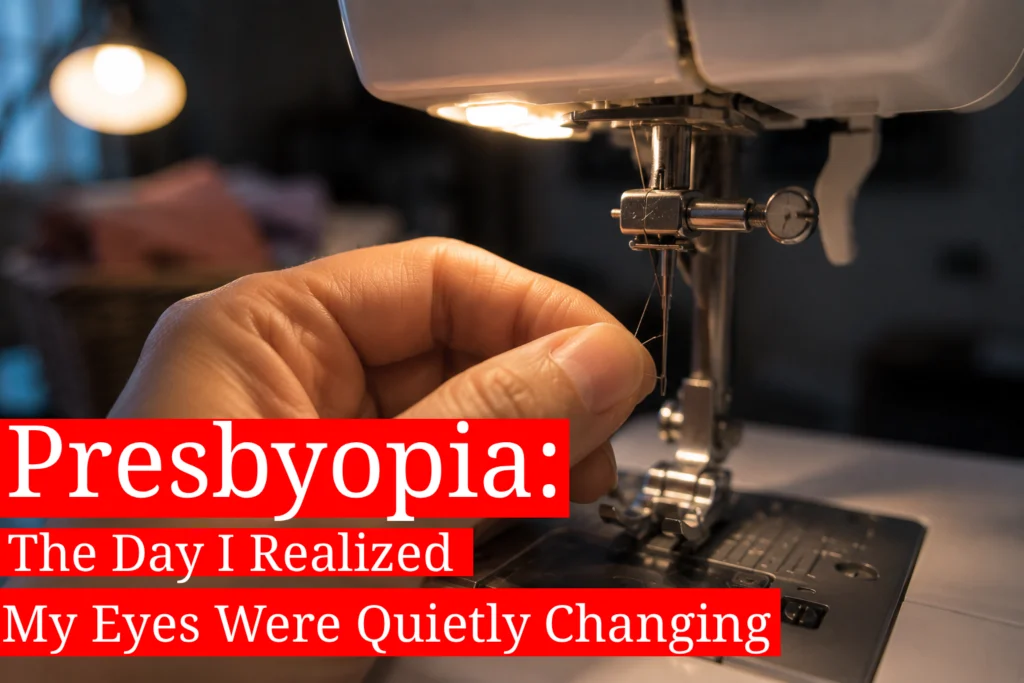
Presbyopia and Near Vision Difficulty While Threading a Sewing Machine

Presbyopia: The Day I Realized My Eyes Were Quietly Changing

There was a time when I could read anything without effort. Tiny letters on medicine covers, small fonts in newspapers, messages on my phone in low light – everything felt easy. I never thought about my eyes because they simply worked. But somewhere after my mid-thirties, I started noticing something strange.

I was holding my phone a little farther away.

At first, I ignored it. I thought maybe my eyes were tired after work or because I spent too much time on the computer. But slowly, that small habit became part of my daily life. Reading WhatsApp messages became easier only when I increased the font size. Book letters started looking crowded. Restaurant menus felt uncomfortable in dim light. I realized something had changed.

That was my first real experience with presbyopia.

The Funny Beginning Nobody Talks About

Most people think eye problems come suddenly, but presbyopia enters life very quietly. You don’t wake up one morning blind to small letters. It happens slowly. One day you stretch your arm a little more while reading. Another day you switch on brighter lights to read comfortably. Later, you start zooming in every document on your phone or laptop.

At first, I blamed mobile phones.

Like many people, I believed excessive screen use had weakened my eyesight completely. I thought years of staring at computers and phones had damaged my eyes forever. But after reading more and talking to others around my age, I understood something important – this happens naturally to almost everyone.

Some notice it at 38. Some at 42. Some even earlier.

The eye’s natural lens slowly loses flexibility with age. That flexibility is what helps us focus on nearby objects. When we are young, the eye adjusts quickly. As age increases, that focusing ability becomes weaker.

That is presbyopia.

When Screenshot Zoom Became My Reading Glass

One habit slowly became part of my daily life without me even noticing it.

Whenever I receive a document, poster, or small text image on my phone, I first take a screenshot of it. Then I zoom into the screenshot to read comfortably. Earlier, I could simply open and read things directly. Now, small text inside posters, advertisements, or PDF files often feels difficult unless I enlarge it.

At first, I thought maybe mobile designers were making fonts too tiny. But later I realized other people around me were reading the same thing comfortably while I was struggling.

That small habit – screenshotting just to zoom and read – became one of the clearest signs that my near vision had changed.


The Sewing Machine Moment That Hurt Me Emotionally

One moment affected me more than anything else.

My mother has a sewing machine at home. Earlier, whenever she needed help, I could easily put the thread into the needle. It was such a simple thing that I never even thought about it.

But nowadays, I struggle to do it.

I try once… twice… three times… and the tiny needle hole refuses to become clear. Sometimes I move the thread farther away, sometimes closer. I even blamed the room lighting and thought our bulb was too dim.

Meanwhile, my mother calmly wears her regular glasses and does it easily within seconds.

That moment honestly disappointed me emotionally.

Not because of the sewing machine itself, but because it made me realize that the problem was no longer the light, the thread, or the needle. The real issue was my eyes changing with age.

It was probably the first time I truly accepted that presbyopia had entered my life.

Modern Life Makes Us Notice It Earlier

Even though presbyopia is natural, I still believe modern digital life makes the symptoms feel stronger.

Years ago, people didn’t spend ten or twelve hours looking at close objects. Today, our eyes continuously focus on:

  • mobile screens
  • laptops
  • tablets
  • smart watches
  • televisions
  • small text notifications

Our eyes rarely get rest.

After a full day of screen work, I could feel heaviness around my eyes. Sometimes the letters became slightly blurry for a few seconds before becoming clear again. During night time, reading became even harder.

I don’t think phones directly “destroy” eyesight the way people fear, but they definitely increase eye strain and make us realize our focusing problems much earlier.

In earlier generations, maybe people noticed presbyopia only while reading newspapers. Today, we notice it every ten minutes because our entire life happens through screens.

The Emotional Side Nobody Mentions

What surprised me most was not the reading difficulty itself. It was the emotional feeling behind it.

Presbyopia quietly reminds you that your body is changing.

When you are young, your body feels automatic. You don’t think about joints, digestion, sleep quality, or eye focus. But after thirty-five, small changes begin appearing one by one. Presbyopia becomes one of those early reminders that time is moving.

The first time I increased the font size on my phone permanently, I felt strange. It sounds funny, but it honestly felt like crossing into another phase of life.

Then I noticed my friends doing the same thing.

One friend started using reading glasses in restaurants. Another began zooming every PDF file during office work. Someone else complained that medicine labels had become impossible to read.

That’s when I understood – this is not a personal weakness. It is a shared human experience.

Why Small Letters Became My Enemy

The most frustrating part of presbyopia is not blindness. It is inconsistency.

Some days my eyes feel perfectly normal. Other days, especially after long screen use, small letters become tiring within minutes.

Low light became my biggest enemy.

Earlier, I could read comfortably in dim rooms. Now I automatically search for brighter lighting. I also noticed that sleep affects eye comfort. If I sleep poorly, reading becomes harder the next day.

Another interesting thing is distance.

If the phone is too close, letters blur slightly. When I move it farther away, clarity improves. That small movement became automatic without me realizing it.

This is probably the most common sign of presbyopia:
holding things farther away to read clearly.

Reading Glasses Are Not Defeat

At first, I resisted the idea of reading glasses.

I thought:
“If I start using glasses now, my eyes will become weaker.”

Many people believe this, but I slowly learned that reading glasses are not making the eyes lazy. They are simply reducing strain.

Using proper glasses is similar to using proper lighting while reading. They help the eyes work comfortably instead of struggling continuously.

Once I accepted that idea, my mindset changed. In fact, that realization later inspired me to write my detailed blog, Presbyopia: Reading Glasses Are Not Defeat, because I understood the real struggle was not only about vision – it was also about ego, fear, and accepting natural changes in life.

There is nothing embarrassing about needing help for near vision after forty. In fact, millions of people experience exactly the same thing. Some just hide it better than others.

Now I understand why many older people carry glasses everywhere:

  • in pockets
  • on office tables
  • inside cars
  • near beds

It is not fashion. It is survival.

How Presbyopia Changed My Screen Habits

One good thing happened because of this experience: I became more conscious about eye care.

Earlier, I could spend hours continuously looking at screens without a break. Now my eyes force me to pause. Surprisingly, that improved my overall comfort.

I started following simple habits:

  • increasing font sizes
  • reducing brightness at night
  • taking short breaks
  • blinking more often
  • avoiding unnecessary screen scrolling
  • keeping proper distance from monitors

I also discovered that dry eyes play a major role. Continuous screen use reduces blinking, which creates irritation and fatigue. Sometimes the problem is not vision power itself but dryness and eye strain together.

Now I understand why older people often prefer printed books over phone reading. Paper feels softer and less aggressive to the eyes compared to bright digital screens.

The Biggest Mistake People Make

Many people panic when they notice presbyopia symptoms.

They immediately think:

“My eyesight is getting destroyed.”
“Mobile phones ruined my eyes.”
“Soon I won’t see properly.”

But presbyopia is not blindness.

It is a normal age-related focusing change.

Of course, proper eye checkups are important because sometimes other conditions like astigmatism or dryness can exist together. But simple near-vision difficulty after the late thirties is extremely common.

The real problem is not presbyopia itself.

The real problem is how modern life demands constant near focus every single day.

Humans were not designed to stare at glowing rectangles for fourteen hours daily.

What I Learned About Aging

Presbyopia taught me something bigger than eye health.

Aging does not happen suddenly. It arrives through small adjustments.

One day you need brighter light.
One day you stretch your arm farther.
One day you increase font size.
One day you buy reading glasses.

Life continues normally, but tiny changes slowly rewrite daily routines.

Instead of fearing these changes, I think acceptance makes life easier.

Our parents experienced this.
Their parents experienced it.
We are simply reaching the same stage.

The difference is that our generation experiences it through smartphones and computer screens instead of newspapers and books.

Can Presbyopia Be Cured After Some Age?

This is a question many people silently ask themselves.

I also wondered:
“Will my eyes become normal again later?”

From what I understand, presbyopia usually does not completely reverse naturally because it happens due to age-related stiffening of the eye’s natural lens. As age increases, the lens loses flexibility little by little.

That means the focusing difficulty may slowly continue over time.

But the positive side is this:
People adapt very well to it.

Some use reading glasses.
Some increase screen sizes.
Some use proper lighting.
Some choose progressive lenses.

After a while, these adjustments become part of normal life, and people stop thinking about it constantly.

So maybe the real “cure” is not becoming twenty years old again- it is learning how to live comfortably with changing eyes without fear or frustration.

The Day I Stopped Blaming the Screen and Started Understanding My Eyes

Today, I no longer feel worried when I zoom text or increase font size. I don’t consider it a weakness anymore. It is simply adaptation.

Presbyopia is not the end of sharp vision. It is just the beginning of understanding our eyes differently.

In fact, this condition taught me to respect my body more.

  • rest matters
  • lighting matters
  • screen habits matter
  • sleep matters
  • eye care matters

Most importantly, I learned that growing older is not about losing ability. It is about learning new ways to stay comfortable.

So if you are in your late thirties or forties and suddenly struggling with small letters, welcome to the club. You are not alone.

Your eyes are not failing.

They are simply changing with time – just like the rest of life.

Moidunni Bava Mundenkkattil Founder & Chairman Nellara & RF Combine

Moidunni Bava Mundenkkattil: The Inspiring Journey of the Founder & Chairman, Nellara & RF Combine

Success stories built from struggle often leave the deepest impact. The life journey of Moidunni Bava Mundenkkattil, the Founder & Chairman, Nellara & RF Combine, is one such story that continues to inspire entrepreneurs across India and the GCC. From starting with a simple bicycle worth 200 dirhams and an old grain mill in Dubai to building a food empire with a turnover of nearly 1,000 crores, his journey reflects determination, honesty, and long-term vision.

Today, the name Nellara is recognized across households in the UAE, India, and many international markets. Behind this trusted brand stands the relentless hard work of Moidunni Bava Mundenkkattil, the Founder & Chairman of RF Combine, who transformed a small dream into one of the most respected food business groups in the region.

Early Life and Humble Beginnings

Born into an agricultural family in Kerala, India, Moidunni Bava Mundenkkattil understood the value of farming, natural products, and hard work from an early age. His upbringing played a major role in shaping his future business philosophy. He learned that quality and honesty are the strongest foundations for any long-lasting enterprise.

Like many Indians during the early 1980s, he traveled to the UAE in search of better opportunities. In 1982, he arrived in Abu Dhabi carrying dreams bigger than his financial situation. Life in the Gulf was not easy during those days. He worked hard, saved carefully, and searched for an opportunity that could create a meaningful future.

The turning point came in 1984 when he purchased a small flour mill called Atiq Abdulla Flour Mill in Dubai. That decision became the foundation of what would later become RF Combine and the globally trusted Nellara brand.

The Vision Behind RF Combine

The food market in the UAE was growing rapidly due to the increasing Indian expatriate population. Many families missed the authentic taste of home-cooked Indian food ingredients. Moidunni Bava Mundenkkattil, the owner of RF Combine, recognized this emotional connection and saw an opportunity to serve people with genuine Indian flour and spices.

With limited resources but strong determination, he focused completely on product quality. His goal was simple – deliver pure, authentic, and trustworthy food products to customers.

In 1986, he launched the first brand under the company, “Rose Flower.” This brand quickly gained popularity among Indian families in the UAE because of its consistent quality and traditional taste. That early success became the stepping stone for future growth.

Unlike businesses that chase rapid profits, the founder & chairman, RF Combine, concentrated on customer trust. Over time, this commitment helped RF Combine grow steadily even in a highly competitive market.

Building Nellara into a Household Name

As the company expanded, the group introduced new products and brands that connected deeply with consumers. Among them, Nellara emerged as one of the strongest and most recognized names.

Today, Moidunni Bava Mundenkkattil, the founder & chairman of Nellara, is widely respected for creating a food brand that represents authenticity and quality. Nellara products became popular not only among Indian expatriates but also among local communities across the GCC.

The success of Nellara did not happen overnight. It was built over decades through discipline, customer understanding, and consistency. From spices and rice products to ready-to-cook solutions, the brand continuously evolved with changing consumer needs while maintaining traditional taste standards.

Under the leadership of the owner of Nellara, the company expanded its reach into more than 25 countries. Manufacturing units were established in both India and the UAE, ensuring efficient production and quality control.

From Small Flour Mill to Global Food Empire

One of the most inspiring aspects of the journey of Moidunni Bava Mundenkkattil is the scale of transformation. What began as a small flour mill has now evolved into a diversified business group with interests in manufacturing, distribution, wholesale, retail, hospitality, and food services.

RF Combine today includes multiple successful brands such as

  • Rose Flower
  • Nellara
  • Malhar
  • Nellstea
  • Nells Café
  • Nells Restaurant
  • FILFILMARKET.COM

Each brand reflects the same values that the company was built upon – quality, trust, and customer satisfaction.

The journey from a bicycle worth 200 dirhams to a billion-level business is not just a financial success story. It is a story about resilience, long-term vision, and disciplined entrepreneurship.

Leadership Style of Moidunni Bava Mundenkkattil

What makes Moidunni Bava Mundenkkattil, the Founder & Chairman, Nellara & RF Combine, different from many business leaders is his grounded personality and practical leadership style.

Instead of focusing only on expansion, he concentrated on creating sustainable systems. He believed in building businesses step by step with strong operational foundations.

Another important aspect of his leadership was welcoming younger talents into key positions. He understood that modern business growth requires fresh ideas and innovation. By empowering the next generation of leadership, he strengthened the company’s ability to adapt to changing markets.

This approach helped RF Combine diversify across different sectors while maintaining stability and long-term growth.

Commitment to Quality and Customer Trust

Throughout his entrepreneurial journey, Moidunni Bava Mundenkkattil repeatedly emphasized one principle – customer trust is everything.

Even during rapid expansion, the company remained focused on maintaining authentic taste and consistent quality. This commitment helped Nellara become emotionally connected with consumers who sought the “Taste of Home” while living abroad.

The owner of RF Combine strongly believed that customers return not because of marketing alone but because of genuine satisfaction with the product. This philosophy became the backbone of the company’s reputation.

Today, millions of customers associate Nellara with reliability, purity, and tradition.

Expansion Across India and GCC

Over the years, the vision of the founder & chairman, RF Combine, expanded beyond the UAE market. The company strengthened its presence across GCC countries and entered the Indian market with renewed focus.

The group’s growing international network reflects its long-term global ambitions. Nellara products are now distributed across several international markets, serving both expatriate communities and local consumers.

The company also entered hospitality and dining segments through ventures like Nells Café and Nells Restaurant, bringing traditional flavors into modern dining experiences.

This diversification demonstrates the forward-thinking mindset of Moidunni Bava Mundenkkattil, who consistently explored new opportunities while protecting the company’s core identity.

Nellara Insta Chef and Modern Innovation

As consumer lifestyles changed, the company adapted quickly to modern food trends. One of the latest innovations introduced by Nellara is “Nellara Insta Chef,” a product range designed for convenient cooking solutions.

The concept focuses on preparing authentic Indian curries within minutes while preserving traditional taste and quality. This reflects the company’s ability to blend convenience with authenticity.

Under the leadership of the founder & chairman, Nellara, the business continues to evolve with modern customer expectations while staying connected to its roots.

The Human Side of Success

Despite achieving remarkable business success, Moidunni Bava Mundenkkattil often speaks about humility, honesty, and gratitude. During Nellara’s 42-year celebration event in Dubai, he reflected emotionally on the company’s journey.

He mentioned that when he started the business, he never imagined the scale it would eventually reach. His original goal was simple – work honestly and provide quality products people could trust.

This mindset explains why the journey of the Owner of Nellara resonates deeply with many aspiring entrepreneurs. His story proves that sustainable success comes from patience, discipline, and genuine commitment.

Leadership Team Driving the Future

The continued success of Nellara and RF Combine is also supported by a strong leadership team. Alongside Moidunni Bava Mundenkkattil, the company’s expansion is driven by Managing Director Shamsudheen Karimbanakkal, Director and CEO MK Fasalu Rahman, and Executive Director Abdulla PK.

Together, they are leading the company into new markets and strengthening operational excellence across multiple sectors.

The vision laid down by the founder & chairman, Nellara & RF Combine, continues to guide the company’s future global expansion plans.

A Story That Inspires Entrepreneurs

The journey of Moidunni Bava Mundenkkattil is more than a corporate success story. It is an inspiring example of how determination and honesty can create extraordinary results.

Many entrepreneurs begin with limited resources, but very few build lasting trust across generations and international markets. The success of the founder & chairman, RF Combine proves that long-term commitment and customer-focused values still matter deeply in modern business.

From a farmer’s background in Kerala to becoming the owner of RF Combine and one of the respected names in the GCC food industry, his story continues to motivate countless business dreamers.

Watch the Exclusive Interview of Moidunni Bava Mundenkkattil

To understand his mindset, entrepreneurial philosophy, and inspiring journey in his own words, watch this interview of Moidunni Bava Mundenkkattil, the founder & chairman of Nellara & RF Combine:


Conclusion

The remarkable rise of Moidunni Bava Mundenkkattil, the founder & chairman of Nellara, stands as one of the most inspiring entrepreneurial journeys in the GCC food industry. From a modest flour mill in Dubai to building a globally trusted food group, his life story represents resilience, discipline, and vision.

As the owner of Nellara and owner of RF Combine, he continues to lead with the same values that shaped the company from the beginning – quality, honesty, and trust.

Even after more than four decades, the journey continues with innovation, expansion, and a strong commitment to serving customers worldwide. The story of Moidunni Bava Mundenkkattil reminds us that true success is not built overnight; it is built through years of consistency, sacrifice, and belief in one’s purpose.